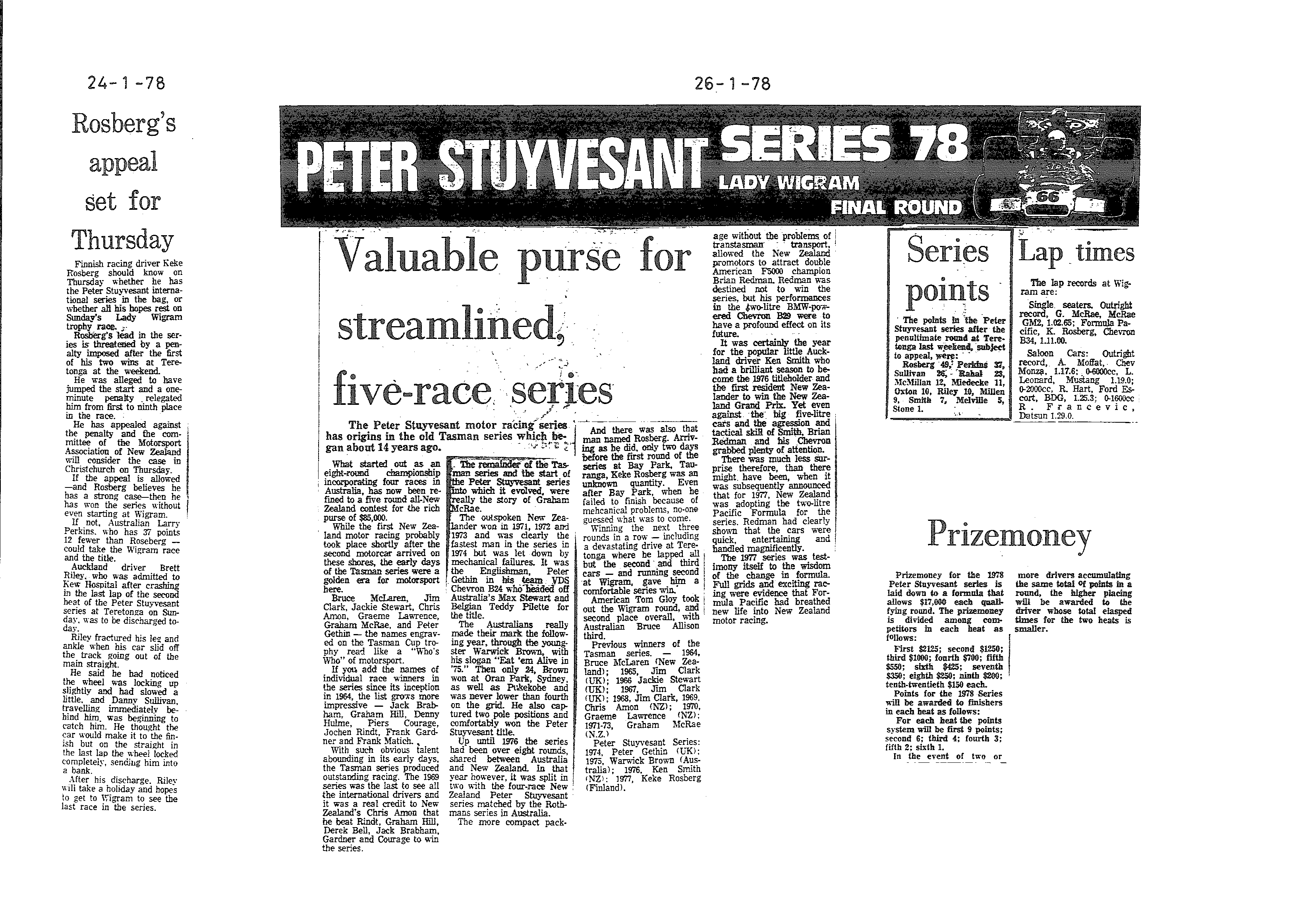
newsRosberg's appeal set for Thursday
Keke Rosberg's 1978 Stuyvesant series lead was threatened by a one-minute penalty for alleged jumping of the start in the first of two heats at Teretonga, dropping him from first to ninth. The MSANZ committee was to hear his appeal on Thursday; if upheld he would win the series without starting at Wigram, otherwise Larry Perkins (37 points, 12 behind) could win the title at Wigram. Brett Riley, who fractured a leg and ankle in a Teretonga crash on the last lap of heat two, was to be discharged from hospital.
Facts
- At Teretonga in January 1978 the series ran in two heats per round; Rosberg won two heats but was penalised one minute for an alleged start jump in the first.
- Before the 1978 Wigram round Rosberg had 49 points and Larry Perkins 37 in the Peter Stuyvesant series.
featureValuable purse for streamlined five-race series
History of the Peter Stuyvesant series from the Tasman series (1964), through winners Clark, McLaren, Stewart, Amon, Lawrence and McRae, to the five-round all-New Zealand 1978 series for $85,000. Keke Rosberg won the 1977 series; Tom Gloy won the Wigram round and Bruce Allison was third.
Facts
- Tasman Cup winners: 1964 Bruce McLaren, 1965 Jim Clark, 1966 Jackie Stewart, 1967 and 1968 Jim Clark, 1969 Chris Amon, 1970 Graeme Lawrence, 1971-73 Graham McRae.
- Peter Stuyvesant series winners: 1974 Peter Gethin, 1975 Warwick Brown, 1976 Ken Smith, 1977 Keke Rosberg.
- The 1978 Peter Stuyvesant series offered $85,000 over five rounds, $17,000 per qualifying round.
- Ken Smith was the first resident New Zealander to win the New Zealand Grand Prix, in 1976.
- Brian Redman's two-litre BMW-powered Chevron B29 in 1976 influenced New Zealand's adoption of the Pacific Formula for 1977.
resultsSeries points, lap records and prizemoney
Series points after Teretonga in 1978 (subject to appeal): Rosberg 49, Perkins 37, Sullivan 26, McMillan 12, Miedecke 11, Oxton 10, Riley 10, Millen 9, Smith 7, Stone 1. Lists Wigram lap records and 1978 prizemoney of $2125 for first through $150 for tenth to twentieth, with points 9, 6, 4, 3, 2, 1.
Lap times
- Graham McRae (McRae GM2): 1:02.65 lap record
- Keke Rosberg (Chevron B34): 1:11.00 lap record
- Allan Moffat (Chev Monza): 1:17.6 lap record
- Leo Leonard (Mustang): 1:19.0 lap record
- R. Hart (Ford BDG): 1:25.3 lap record
- Robbie Francevic (Datsun): 1:29.0 lap record
Facts
- Wigram lap records in January 1978: single-seater outright Graham McRae 1:02.65, Formula Pacific Keke Rosberg 1:11.00, saloon outright Allan Moffat 1:17.6.
- 1978 Stuyvesant prizemoney per round: first $2125, second $1250, third $1000, fourth $700, fifth $550, sixth $425, seventh $350, eighth $250, ninth $200, tenth to twentieth $150.
Read the OCR text
24-1-78 26-9-78
Rosberg'
appeal
set for
Thursday
Finnish racing driver Reke
Rosberg should know or
Thursday whether he has
the Peter Stuyvesant international series in the bag, or
whether all his hopes rest on
Sunday's Lady Wigram
trophy race.
Rosberg's lead in the series is threatened by a pen
alty imposed after the first
of his two wins at Teretonga at the weekend.
He was alleged to have
jumped the start and a oneminute penalty. relegated
him trom first to ninth place
i the race.
He has appealed against
the penalty and the committee of the Motorsport
Association of New Zealand
will consider the case in
Christchurch on Thursday.
If the appeal is allowed
-and Rosberg believes he
has a strong case-then he
has won the series without
even starting at Wigram.
If not. Australian Larry
Perkins. who has 37 points
12 fewer than Roseberg could take the Wigram race
and the title driver Auckland Brett
Riley. who was admitted to
Kev Hospital after crashing
in the last lap of the second
heat of the Peter Stuyvesant
series at Teretonga on Sunday, was to be discharged today.
Riley fractured his leg and
ankle when his car slid off
the track going out of the
main straight.
He said he bad noticed
the wheel was locking up
slightly and had slowed a
little. and Danny Sullivan,
travelling immediately behind him, was beginning to
catch him. He thought the
car would make it to the finish I but on the straight in
the last lap the wheel locked
completels, sending him into
a bank.
After his discharge. Riley
will take a holiday and hopes
to get to Migram to see the
last race in the series.
PETER ST
-SAN
Valuable
purs
for
streamlined,
five-ra
ce: ser
The Peter Stuyvesant motor racing series.
has origins in the old Tasman series which be.
gan about 14 years ago.
What started out as
eight-round championship
incorporating four saces in
Australia, has now been refined to a five round all New
Zealand contest for the rich
purse of $85,000.
While the first New Zealand motor racing probably
took place shorty aiter the
second motorcar arrived on
these shores, the early days
of the lasman seres were a
golden era for motorsport
here.
Bruce McLaren, Jim
Clark, Jackie Stewart, Chris
Amon, Graeme Lawrence,
Granam MeRae, and Peter
Gethin - the names engraved on the Tasman Cup trophy read like a "Who's
Who" of motorsport.
I you add the names of
individual race winners in
the series since its inception
in 1964, the list grows more
impressive - Jack Brabham, Graham Hill, Denny
Hulme, Piers Courage,
Jochen Rindt, Frank Gardner and Frank Matich Falent With such obvious
abounding in its early days,
the Tasman series produced
outstanding racing. The 1969
series was the last to see all
the international drivers and
it was a real credit to New
Zealand's Chris Amon that
he beat Rindt, Graham Hill,
Derek Bell, Jack Brabham,
Gardner and Courage to win
the series.
The remainder of the Tas
man series and the start of
the Peter Stuyvesant series
finto which it evolved, were
Teally the story of Graham
McRae.
The outspoken New Zeabander won in 1971, 1972 and
1973 and was clearly the
fastest man in the series in
1974 but was let down by
mechanical fallures. It was
the Englishman, Peier
Gethin in bis team: • VDS
Chevron B24 who headed off
Australia's Max Stewart and
Belgian Teddy Pilette for
the title.
The Australians really
made their mark the following year, through the young.
ster warwick Brown, with
his slogan "Eat 'em Alive in
"75." Then only 24, Brown
won at Uran park, Sydney,
as well as Pusekobe and
was never lower than fourth
on the grid. He also captured two poie positions and
comfortably won the Peter
Stuyvesant title.
Up until 1976 the series
had been over eight rounds,
shared between Australia
and New Zealand. In that
year however, it was split in
two with the four-race New
Zealand Peter Stuyvesant
series matched by the Rothmans series in Australia.
The more compact pack-
es
And there was also that
man named Rosberg. Arriving as he did, ory two days
before the first round of the
series at Bay Park, Tauranga, Reke Rosberg was an
quantity. Even
after Bay Park, when he
failed to finish because of
mehcanical probiems, no-one
guessed what was to come.
Winning next three
rounds in a row - including
a devastating drive at Teretonga where be lapped all
but the second and third
cars - and running second
at Wigram, gave him a
comfortable series win.
American Tom Gloy took
out the Wigram round, and
second place overall, with
Australian Bruce Allison
third.
Previous winners of the
Tasman series. - 1964,
Bruce McLaren (New Zealand); 1965, Jim Clark
(UK); 1966 Jackie Stewart
(UK): 1967, Jim Clark
(UK); 1968, Jim Clark, 1969.
Chris Amon (NZ); 1970,
Graeme Lawrence (NZ) ;
1971-73, Graham McRae
(N.Z.)
Peter Stuyvesant Series:
1974, Peter, Gethin (UK);
1975, Warwick Brown (Australia); 1976, Ken Smith
(NZ) : 1977, Keke Rosberg
(Finland).
SER
LADY WIGR
age without the problems of
transtasman transport,
allowed the New Zealand
promotors to attract double
American F5000 champion
Brian Redman. Redman was
destined not to win the
series, but his performances
in the two-litre BMW-po#ered Chevron B29 were to
have a profound effect on its
future.
It was certainly the yeal
for the popular litte Auckland driver Ken Smith who
had a brilliant season to become the 1976 titleholder and
the first resident New Zealander to win the New Zealand Grand Prix. Yet even
against the big five-litre
cars and the agression and
tactical skill of Smith, Brian
Redman and bis Chevron
grabbed plenty of attention.
There was much less surprise therefore, than there
might. have been, when it
was subsequently announced
that for 1977, New Zealand
was adopting the two-litre
Pacific Formula for the
series. Redman had clearly
shown that the cars were
quick, entertaining and
handled magnificently.
The 1977 series was testimony itself to the wisdom
of the change in formula.
Ful grids and exciting racing were evidence that Formula Pacific had breathed
new life into New Zealand
motor racing.
ES
AM
FINAL ROUND
Series Lap times
points
•The points in the Peter
Stuyvesant series after the
penultimate round at Teretonga last weetend, subject
to appeal, were:
Rosberg 49, : Perking 37,
Sullivan 26, - "Rahal
McMillan 12, Miedecke 11,
Oxton 10, Riley 10, Millen
9, Smitie 7, Melville
Stone 1.
The lap records at Wig
ram are:
Single. seaters. Outrigh:
record, G. Michae, McRae
GMZ, 1.02.65; Formula Pacific, K. Rosberg, Chevron
B34, 1.11.00.
Saloon Cars: Outright
record,. A. Moffat, Chev
Monza, 1.17.6; 0-6000cc, L.
Mustang _ 1.19.0;
Leonara, R. Hart, Ford ES- 0-2000cc, cart, BDG, 1.25.3; o-1600cc
R • Francevie,
Datsun 1.29.0
Prizemonev
Prizemoney for the 1978
Peter Stuyvesant series is
laid down to a formula that
allows $17,000 each quali
fying round. The prizemoney
is divided among competitors in each heat as
follows:
First $2125; second $1250;
third $1000; fourth $700; fifth
$550; sixth $425; seventh
$350; eighth $250; ninth $200;
tenth-twentieth $150 each.
Points for the 1978 Series
will be awarded to finishers
in each beat as follows:
For each heat the points
system will be first 9 points;
second 6; third 4; fourth 3;
fith 2; sixth 1.
In the event of two or
more drivers accumulating
the same total of points in a
round, the higher placing
will be awarded to the
driver whose sotal elasped
times for the two heats is
smaller.
Summaries and tables are machine-read from the scan and may contain errors: the scan is the record.