previewFine tuning makes the difference
Explains why Saturday practice and qualifying matter at Wigram: choosing gear ratios against the Christchurch north-easter on the back straight, suspension and wing settings, and grid position. The 44-lap Lady Wigram race pays $3000, $2000 and $1500 to the first three, and the fastest qualifier in each of the five Stuyvesant rounds wins a Citizen wristwatch.
Lap times
- Mikko Kozarowitzky: 1:05.5 qualifying
- Keke Rosberg: 1:05.6 qualifying
Facts
- The 1977 Lady Wigram Trophy was run over 44 laps; prize money was $3000 for first, $2000 for second and $1500 for third.
- Kozarowitzky took pole for the 1977 NZ Grand Prix at Pukekohe by 0.1 sec from Rosberg (65.5 to 65.6).
- After the Manfeild qualifying, Rosberg had won two Citizen watches and Kozarowitzky one for fastest qualifying in the 1977 series.
Photos
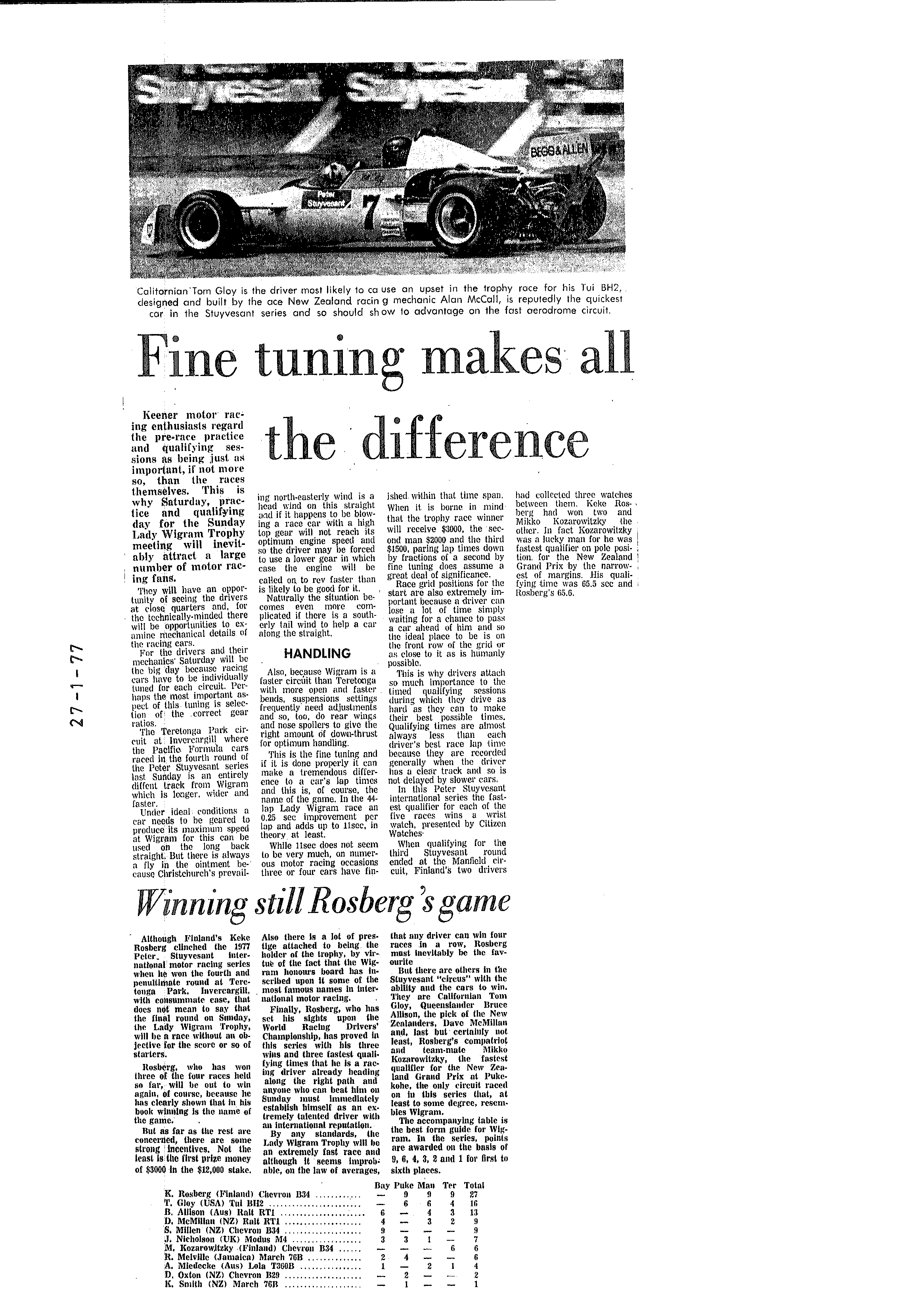
- Californian Tom Gloy in the Tui BH2 designed and built by Alan McCall.
previewWinning still Rosberg's game
Keke Rosberg clinched the 1977 Peter Stuyvesant series by winning the fourth round at Teretonga, having won three of four races and three fastest qualifying times. The Wigram race still offered $3000 first prize in a $12,000 stake. Gloy, Allison, McMillan and Kozarowitzky were seen as his main threats; series points are awarded 9, 8, 4, 3, 2, 1 for first to sixth.
Facts
- Keke Rosberg clinched the 1977 Peter Stuyvesant series with a win at Teretonga in the fourth round.
- The 1977 Stuyvesant series stake was $12,000 per meeting, $3000 to the Wigram winner.
Read the OCR text
BEGG&ALLEN
Calitornian Tom Gloy is the driver mast likely to cause an upset in the trophy race for his Tui BHZ,
designed and built by the ace New Zealand racing mechanic Alan McCall, is reputedly the quickest
car in the Stuyvesant series and so should show to advantage on the fast aerodrome circuit.
Fine
tuning
mak
Keener motor racing enthusiasts regard
the pre-race practice
and qualifying sessions as being just as
important, il' not more
so, than the races
themselves. This is
why Saturday, pracfice and qualifying
day for the Sunday
Lady Wigram Trophy
meeting will inevitably attract a large
number of motor racing fans.
They will have an opporlumity of seeing the drivers
at close quarters and, tot
the technically-minded there
will be opportunities to examine mechanical details of
the racing cars.
For the drivers and their
mechanics' Saturday will be
the big day because racing
cars have to be individually
tuned for each circuit. Perhaps the most important aspect of this tuning is seleclion of the correct gear
ratios.
The Terelonga Park circuit at Invercargil! where
the Pacifie Formula cars
raced in the fourth round of
the peter stuyvesant series
last Sunday is an entirely
diffent track from Wigram
which is longer, wider and
laster.
Under ideal: conditions a
car needs to be geared to
produce its maximum speed
at Wigram for this can be
tased the long back
straight, But there is always
a fly in the ointment because Christchurch's prevail-
the differe
ing north-easterly wind is a
head wind on this straight
and if it happens to be blowing a race car with a high
top gear will not reach its
optimum engine speed and
so the driver may be forced
to use a lower gear in which
case the engine will be
called on to rev faster inan
is likely lo be good for it.
Naturally the situation be:
comes even more complicated if there is a southerly tail wind to help a car
along the straight.
HANDLING
Also, because Wigram is a
faster circuit than Teretonga
with more open and faster
bends, suspensions settings
Irequently need adjustments
and so, too, do rear, wings
and nose spoilers to give the
right amount of dowar-thrust
for optimum handling.
This is the fine tuning and
if it is done properly it can
make a tremendous difference to a car's lap times
and this is, of course, the
name of the game. In the 44lap Lady Wigram race an
0.25 sec improvement pcr
lap and adds up to 11sec, in
theory at least.
While 1isec does not seem
to be very much, on numer•
ous motor racing occasions
three or four cars have fin-
ished. within that time span.
When it is borne in mind
that the trophy race winner
will receive $3000, the seeond man $2000 and the third
$1500, paring lap times down
by fractions of a second by
fine tuning does assume a
great deal of significance.
Race grid positions for the
start are also extremely im-
Portant because a driver cun •a lot of time simply
waiting for a chance to pass
a car ahead of him and so
the ideal place to be is on
the front row of the grid or
as close to it as is humanly
possible.
This is why drivers atlach
so much importance to the
Limed quaillying sessions
during which they drive as
hard as they can to make
their best • possible times.
Qualifying times are almost
always less than cach
driver's best race lap lime
because they are recorded
gencrally when the ariver
has a clear track and so 1s
not delayed by slower cars.
In this Peter Stuyvesant
international series the fastest qualifier for each of the
five races wins a wrist.
watch, presented by Cilizen
Watches
When qualifying for the
thild stuyvesant • round
ended at the Mantield circuit, Finland's two drivers
Winning still Rosberg's game
Although Finland's Keke
Rosberg clinched the 1977
Peter. Stuyvesant internattonal motor racing series
when he won the fourth and
penullimate round at Teretonga Park, Invercargill,
with consummate ease, that
does not mean to say that
the final round on Sunday,
the : Lady Wigram Trophy,
will be a race without an oblective for the score or so of
starters.
Rosberg, who has won
three of the four races held
in far, will be out to win
again, of course, because he
has cicarly shown that in his
book winning is the name of
the game.
But as far as the rest are
concerned, there are some
strong incentives. Not the
least is the first prize money
of $3000 in the $12,000 stake.
Also there is a lot of prestige attached to being. the
holder of the trophy, by vil-.
tue of the fact that the Wigram honours board has inscribed upon it some of the
most famous names in internatlonal motor racing.
Finally, Rosberg, who has
set his sights upon
World Racing Drivers'
Champlonship, has proved in
this series with his three
wins and three fastest qualifying limes that he is a racing driver already heading
along the right path and
anyone who can beat him ou
Sunday must immediately
estabiish himself as an extremely talented driver with
an international reputation.
By any standards, the
Lady Wigram Trophy will be
an extremely fast race and
although it seems improb;
able, on the law of averages,
Ba:
K. Rosberg (Finland) Chevron B34
T. Gloy (USA) Tul BH2
B. Allison (Aus) Ralt RTI
D, McMillan (NZ) Ralt RT1
S. Millen (NZ) Chevron B34
J. Nicholson (UK) Modus M4 3
M1. Kozarowitzky (Finland) Chevron B34
R. Melville (Jamaica) March 76B 2
A. Miedecke (Aus) Lola T360B
D. Oxton (NZ) Chevron B29
K. Smith (NZ) March 76B
that any driver can win four
races in a row, Rosberg
mast inevitably be the fayourite
But there are others in the
Stuyvesant "cireus" with the
ability and the cars to win.
They are Calffornian Tom
Gloy, Queenslander Bruce
Allison, the pick of the New
Zealanders, Dave McMillan
and, last but certainly not
least, Rosherg's compatrio!
ани team-male Mikko
Kozarowitzky, the fastest
qualifier for the New Zealand Grand • Prix at Pukekohe, the only circuit raced
on in this series that, at
least to some degree, resentbies Wigram.
The accompanying table is
the best form guide for Wigram. In the series, points
are awarded on the basis of
9, 8, 4, 3, 2 and 1 for first to
sixth places.
P uke Man Ter Total
9 27
essa 5920
∞/11 1
mtor
трон
es all
nce
had collected three watches
between them. Beke Rosberg had Won two and
Mikko Kozarowitzky the
other. In fact Kozarowitzky
was a lucky man for he was
fastest qualifier on pole position. for the New Zealand
Grand Prix by the narrowest of margins. His qualifying time was 65.5 sec and
Rosberg's 65.6.
Summaries and tables are machine-read from the scan and may contain errors: the scan is the record.