Read the OCR text
12-9-71
NIERNAT
Satur
"day's
contest
third
round in
annual
series
The international Lady Wigram Troph
round in the annual New Zealand-Australia
1964 for the express purpose of giving residen
compete on favourable terms with overseas d
The original Tasman For- being the late Bruce
mula imposed an engine cap- McLaren, who raced a
acity limit of 2.5 litres and Cooper-Climax.
cars had to be single-seater Other champions were the
open-wheelers, running on late Jim Clark, who, driving
petrol with a maximum rat- Lotuses, won the title on
ing of 30 octane, known in three occasions, and the 1969
the sport as "Avgas," or world champion, Jackie
aviation gasoline. Stewart, who drove a 2-itre
Right from the outset, the BRM V8.
series was dominated by in- Resident drivers of New
ternationally ranking Zealand and Australia seldrivers, the first champion dom had a look in and so, for
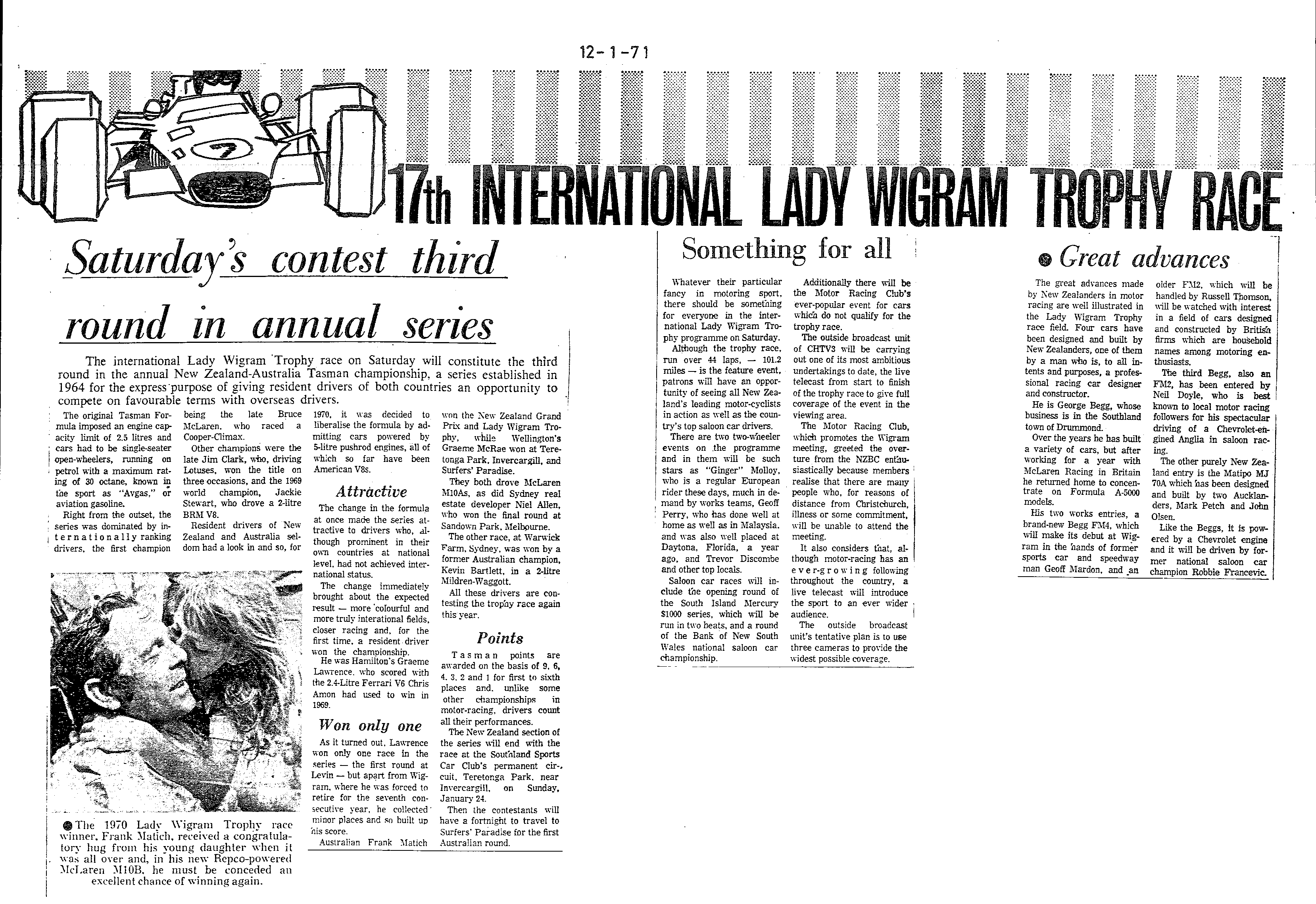
• The 1970 La
winner. Frank Ma
tory hug from h
was all over and,
Mel.aren
excellent ch
dy Wigram Trophy race
atich, received a congratulais young daughter when it
, in his new Repco-powered
he must be conceded an
ance of winning again.
зу race on Saturday will
Tasman championship, a
it drivers of both countrie
Irivers.
constitute the third
series established in
an opportunity to
1970, it was decided to
liberalise the formula by admitting cars powered by
5-litre pushrod engines, all of
which so far have been
American V8s.
Attractive
The change in the formula
at once made the series attractive to drivers who, although prominent in their
own countries at national
level, had not achieved international status.
The change immediately
brought about the expected
result - more "colourful and
more truly interational felds,
closer racing and, for the
first time, a resident driver
won the championship.
He was Hamilton's Graeme
Lawrence. who scored with
the 2.4 Litre Ferrari V6 Chris
Amon had used to win in
1969.
Won only one
As it turned out, Lawrence
won only one race in the
series - the first round at
Levin - but apart from Wigram, where he was forced to
retire for the seventh con-
secutive year, he collected
minor places and so built up
his score.
Australian Frank Matich
won the New Zealand Grand
Prix and Lady Wigram Trophy, while Wellington's
Graeme McRae won at Teretonga Park. Invercargill, and
Surfers' Paradise.
They both drove McLaren
NIlAs, as did Sydney real
estate developer Niel Allen,
who won the final round at
Sandown Park, Melbourne.
The otber race, at Warwick
Farm, Sydney, was won by a
former Australian champion,
Kevin Bartlett, in a 2-litre
Mildren-Waggott.
All these drivers are contesting the tropay race again
this year.
Points
Tasman points are
awarded on the basis of 9, 6,
4. 3. 2 and 1 for first to sixth
places and. unlike some
other championships in
motor-racing, drivers count
all their performances.
The New Zealand section of
the series will end with the
race at the Soutniand Sports
Car Club's permanent circuit. Teretonga Park, near
Invercargill, on Sunday,
January 24.
Then the contestants will
have a fortnight to travel to
Surfers' Paradise for the first
Australian round.
.....
INAL
LADY W
Something for all
Whatever their particular
fancy in motoring sport,
there should be sometning
for everyone in the international Lady Wigram Irophy programme on Saturday.
Although the trophy race,
run over 44 laps, — 101.2
miles — is the feature event,
patrons will have an opportunity of seeing all New Zealand's leading motor-cyclists
in action as trell as the country's top saloon car drivers.
There are two two-wheeler
events on the programme
and in them will be such
stars as "Ginger" Molloy,
who is a regular European
rider these days, much in demand by works teams, Geoff
Perry, who has done well at
home as well as in Malaysia.
and was also well placed at
Daytona, Florida, a year
ago, and Trevor Discombe
and other top locals.
Saloon car races will include the opening round of
the South Island Mercury
$1000 series, which will be
run in two beats, and a round
of the Bank of New South
Wales national saloon car
championship.
Additionally there will be
the Motor Racing Club's
ever-popular event for cars
which do not qualify for the
trophy race.
The outside broadcast unit
of CHTV3 will be carrying
out one of its most ambitious
undertakings to date, the live
telecast from start to finish
of the trophy race to gire full
coverage of the event in the
viewing area.
The Motor Racing Club,
which promotes the Wigram
meeting, greeted the overture from the NZBC entausiastically because members
realise that there are many
people who, for reasons of
distance from Christchurch,
illness or some commitment,
will be unable to attend the
meeting.
It also considers taat, although motor-racing has an
ever-growing following
throughout the country, a
live telecast will introduce
the sport to an ever wider
audience.
The outside broadcast
unit's tentative plan is to use
three cameras to provide the
widest possible coverage.
GRAM
TROP
Great
RACE
advances
The great advances made
by New Zealanders in motor
racing are well illustrated in
the Lady Wigram Trophy
race fiela. Four cars have
been designed and built by
New Zealanders, one of ther
by a man who is, to all intents and purposes, a professional racing car designer
and constructor.
He is George Begg, whose
business is in the Southland
town of Drummond.
Over the years he has built
a variety of cars, but alter
working for a year with
McLaren Racing in Britain
he returned home to concentrate on Formula A-5000
models.
His two works entries, a
brand-new Begg FM4, which
will make its debut at Wigram in the hands of former
sports car and speedway
man Geoff Mardon, and an
oider F112, which will be
handled by Russell Thomson,
will be watched with interest
in a field of cars designed
and constructed by Britisa
firms which are household
names among motoring enthusiasts.
The third Begg, also an
FM2, has been entered by
Neil Doyle, who is best
known to local motor racing
followers for his spectacular
driving of a Chevrolet-engined Anglia in saloon racing.
The other purely New Zealand entry is the Matipo MJ
70A which has been designed
and built by two Aucklanders, Mark Petch and John
Olsen.
Like the Beggs, it is powered by a Chevrolet engine
and it will be driven by former national saloon car
champion Robbie Francevic.
Summaries and tables are machine-read from the scan and may contain errors: the scan is the record.