Read the OCR text
15-1-69
British
Cars
With the notable The BRM, fitted with a 16exception of the Fer- cylinder supercharged
litre engine, was entered for
raris driven by Chris its first race at Silverstone
Amon and Derek Bell, almost against the wishes of
the BRM team.
the grid at Wigram Their apprehension was
on Saturday will be justified. As French driver
filled with British- Raymond Sommer let in the
made racing ears, with clutch in his position at the
back of the grid the trans.
British-made engines. mission failed and the car
this was wheeled away to the pad-
Fifteen years ago dock. However, the team
would not have been the case. persevered with the 16-
It is only in the last 15 years cylinder engine until the end
that British cars have come to of the 1955 season when the
the fore in motor-racing, but FLA. changed the existing
¡so notable have been the sue- Formula I regulations.
cesses of British cars since
Even under the new formthen, that to many it seemstula, when the team developed
that British cars have always a new 25 litre engine, the car
• been the ones to beat.
The cars that will race at had a very chequered career and it was not until 1958 that
Wigram on Saturday have all, the car really began to show
with the exception of the Fer any of the promise that it!
¡raris. come to the top in the was later to fulfil.
last decade. Fifteen years ago
Lotus, Cooper, Brabham and VANWALL
McLaren were names
The B.R.M. project had
lowers of motor-sport. were unknown to most fol been originally financed by a
backers,
1955, a ratish "Conaught, from within the motor induspowered by an Alta engine, try, and it was ope of these
had shocked the motor sport- men- the late Tony Vandering world by winning vell-who first put British
Syracuse Grand Prix. Shocked cars on the Grand Prix map.
was no esaggeration; for in Vandervell, founder of
gaining an outright win the wall Products, was bitterly
car, driven by Tony Brooks (disappointed by the B.R.M.'s
was competing in his consistent lack of success and:
Formula I race, he decided to "go it alone."
quished a four-car Maserati From development work
team and broke the existing carried out towards the end
lap record three times. ¡of the previous Formula 1,
result certainly on a 4o litre. Ferrari-based
shocked the race organisers.i ¡"Thinwall Special," he intro-
They ordered a complete ex- duced a brand new Formula 1,
amination of the car after the car, called the vanwall. That
race to ensure that it com-i 1 was in 1904.
plied with existing 2.5 litre It was subject to a great
Formula I regulations. ¡deal of modification before it
gained its first success. In
FIRST BRI 1956 the four-cylinder fuel-i
These were still early days injected Vanwall, running on
for British Formula i cars. potable cito agast an but almost since the end of
the Second World War a international field, including
racing driver-engineer named Juan Fangio, at Silverstone
Raymond Mays had been in the International Trophy.
bursting with the idea of For the 1956 season the car!
sported a new chassis debuilding an all-British
Formula I car to challenge signed by Colin Chapman,
the world. The car was named (later to gain fame as a manuthe BRM and was designed by (facturer in his own right.
a team that had previously In 1957 the Vanwall gained
designed a • famous pre-war international acclaim with its
racing car-the BRA. i success at the British Grand
At Th
Pris at Aintree driven by
Tony Brooks and Stirling
Moss, who took it over the
line after his own car had
drapped out. Later Brooks
repeated his Syracuse
Formula 1 success by winning
with Vanwall at Pescara. Moss
continued the winnings ways
at the extremely fast italian
Grand Prix at Monza.
HISTORIC SEASON
The 1958 season that followed was a truly historic
оде for Britain. Vanwall de
velopment reached its climax. The car won six of the
11 Grand Prix events counting towards the World Championship. And Tony Vandervell won the World Championship for Manufacturers.
Coopers won the Formula II
World Championship, and
British drivers gained the
first three places in the World
Drivers' Championship:
The 1959 Season started
with a bombshell, however.
Because of ill health Vandervell was to retire from racing. Although the team announced that they would be
entering a car for selected
events, no organised programme of racing was being
planned. If nothing else the
decision left two of tbe
world's finest drivers, Tony
Brooks and Stirling Moss,!
without cars for the forthcoming season.
But already a new namel
was beginning to emerge
the name that was to be the
foundation of Britain's Grand
Pris effort over the next few
years.
Coopers, as well as winning
the Formula Il World Championship, gained two major
Formula I successes in 1958
-the Argentine and Monaco
Grand Pris, when privately
entered cars of the Robi
Walker team driven by Stirling Moss gained outright victories. The cars were rearengined with Coventry Climax
power units over half-a-litre
smaller than their competitors.
In the next season Coopers
e Top
gained the world. constructOrs championship using a
new 2.5-litre Coventry Climax engine, winning nine out
of the 11 Grand Prix events.
The success was repeated in
1960 when once again the
coveted constructors' award
went to Coopers.
The years from 1957 to 1960
had been halcyon years for
British constructors and enthusiasts, but 1961 was to
bring disappointment. The
existing Formula I-750 c.c.
supercharger, or 2.5 litre unsupercharged - bad been
standing since 1954,
The new formula proposed
by the F.LA-15-litres unsupercharged-met with little
support from the successful
British manufacturers who, in
an attempt to extend the
formula, delayed work on the
new cars and engines.
Although Coventry Climax
had an engine available it did
not produce sufficient power
to match its foreign rivals.
It was in 1962 that B.R.N.
The successful car was a brand-new
design with a V8 engine, the
previous season the cars had
. used Coventry Climax units
while waiting for their own
engines.
The car lived up to its
promise and won four of the
¡year's nine Grand Prit events,
¡ gained three seconds and the
Constructors' Championship,
land the team driver, Graham
Hill—Number 1 for Gold Leaf
Team Lotus at Wigram on Sat-
Turday—won the drivers' world
championship.
The eight-cylinder
B.R.M. engine powered not
only the team cars but privately entered cars as well.
The new Coventry Climax engine was used in the Cooper
land Lotus cars, and in a car
designed by the then former
world champion, Jack Brabham.
With the exception of the
French Grand Prix, British
cars won every one of the
nine events counting towards
the world championship.
The 1963 season was the
year of the Lotus. Colin Chapman had had a great deal to
do with the design of the
chassis and suspension of the
• successful Vanwall, and bis:
early forays into Formula I
racing had been with cars!
• to the 1957 Vanwalls. bearing a great resemblance The
newspapers called them "mini-!
ature" Vanwalls.
But he followed • the lead
set by Coopers and introduced
his first rear-engined car in
1959. In 1962 the Lotus cars
proved themselves extremely
hability to rob B.R.M. of the
world championship.
By the next season the!
cars had found their form,,
and after a year . of hard-i
fought battles with B.R.M.
won seven of the year's 10!
Grand Prix events giving
Colin Chapman the Constructors* Championship and Jim
Clark the drivers' title.
A season of surprises would
be the best way of summing
up the 1964 season. Lotus and
B.R.M. spearheaded the
attack, but unreliability and
bad luck combined with a
strong challenge from the
Ferrari equupe cost both
manufacturers the champion.
ship, which went to Ferrari.
SUPREMACY
The last season of thei
, much-maligned 1.5 litre for-i
mula, which in spite of its
¡crities had produced close
racing, once again proved
the supremacy of British cars.
Lotus won the World Championship, team driver Jim
Clark won the Drivers'
Award.
The new 3-litre Formula I
Icame into being in 1966. In
contrast to the 1.5-litre limit,
this move was welcomed by
the majority of manufacturas : well as the drivers.
Australian Jack Brabham,
who had won two World
Drivers' Championships while
with Cooper, won the championship for the third time.
He thus became the first man
ever to win the Constructors
Award driving his own make
of car. Brabham had left the
Cooper works teams in 1961:
to build and race his own!
• machines and his Coventry
Climax rear engined cars had
¡always been a threat to the
¡larger works teams during
162, 63, "64 and '65.
The start of the 66 seaison had brought the almost
traditional problem of power
¡units to the British teams.
Coventry Climax, who had
; manufactured the engines for
¡Lotus, Cooper and Brabharo,
las well as a number of the
private entrants, had altpounced their retirement
from motor racing.
Of the British teams only!
B.R.M.—backed by the large.
¡Owen organisation-had the
facilities to design and build
¡their own engines. Cooper
turned to Maserati for en
igines, and Lotus announced
that Ford of Britain was to
¡supply the team's engines, but;
¡until the new units became
available they would use one
tof the old Coventry Climas
‚engines, or one of the H-16
(engines designed and built
by B.R.M.
REPCO-BRABHAN
Brabham announced that
he was to use an engine developed by the Australian
Repeo concern.
At the begining of the sea
son only Ferrari, cooper,
Brabham and B.R.M. looked
like being competitive and of
these many people had written of the "simple" Repco
engine. But Brabham had the
last laugh; his superb driving
together with the Kepco
engine and the space-frame
car was the recipe that won
the World Championship for
both constructor and builder.
The 1967 season was the
second year of the 3-litre formula. Lotus had the new'
:Ford-Cosworth engine which
won the first race for which it
was entered, as well as the
British G.P. The B.R.M.
engine had found the neces
sary reliability but its drivers
were dogged by persistent ill
luck.
Coopers, in search of more
power, used a new (threevalve-per-cylinder) cylinderhead for their Italian designed engine and at the Br
tish G.P: unveiled a new lightweight car.. The winning
Brabham team had a more
powerful version of the previous year's Repco engine in
the same chassis.
As all New Zealand followi
ers= of motor-sport know,
Denis Hulme took the reliable Brabhams to victory in
the world championship, be
coming the first New Zealander to gain the coveted
award.
awards again went to Later And last "year
although Hulme, now driving
for the McLaren team, was in
the running until the last!
Although the Lotus team had
suffered a severe loss through
the death of remarkable and
universally-admired Jim
Clark, his skilled and popular
team-mate, . Granam .- HitE
brought the team the victory
it deserved.
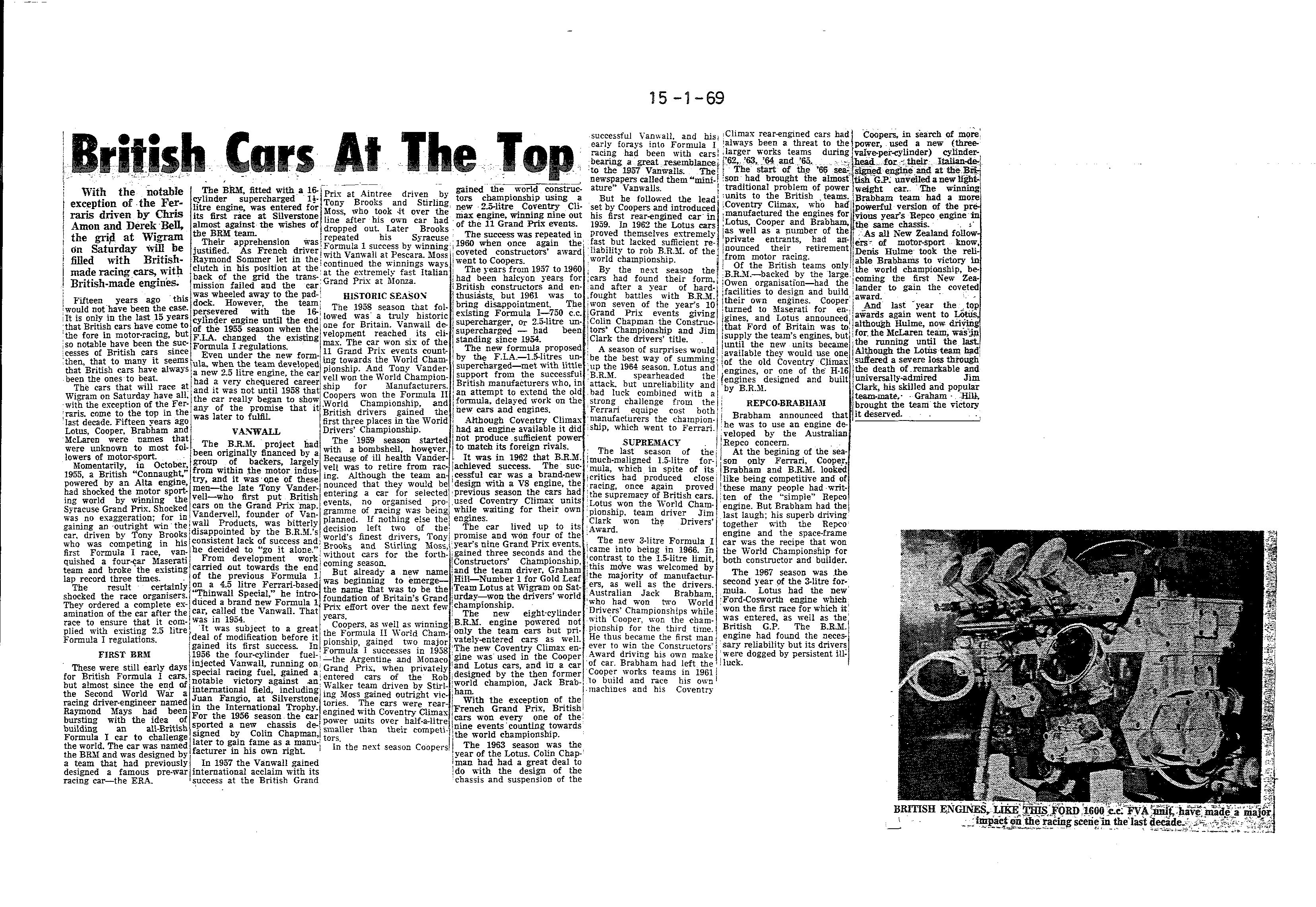
BRITISH ENGINES, LIKE THIS FORD 1600 ce. TVA amit, have made a major
impact on the racing scene in the last decade
Summaries and tables are machine-read from the scan and may contain errors: the scan is the record.