Read the OCR text
15-1-69
N.Z..
The famous New
Zealand racing team
of Bruce McLaren and
Denis Hulme is not
racing in the Tasman
series this year, but
the team will be represented in some way
at. Wigram on Saturday.
The young driver, Graeme
Lawrence, who spent several
months in Britain with the
McLaren team last year, will
race the latest McLaren
Formula II 1600 c.c. car in
the main erent.
The last season has been the
most successful one ever for
the Mclaren racing team and
its cars.
Phil Kerr, joint managing
director of Bruce McLaren
Racing Limited, sees his company's world-beating M8A
Can-Am cars, and the
Formula I cars which gained
second place in the World
Constructors' Championship
plex year as "simply com-
Although highiy advanced
technically, simplicity, finding and using the easiest way
of designing and building, is
a digoly sougat atter objective at the . headquarters of
Mclaren Motor Racing, near
London's Heathrow airport.
In 1967 Bruce McLaren won
the Can-Am series of races
driving a McLaren: M6A,
whilst Denny Hulme gained
Tea
m's
Best
Sea
son
¡second place. Last year the
positions were reversed with
ilme first and Bruce
McLaren second and the team
gained four wins in the . SiX
events. These two successes
earned the team a total of
S337,000 in prize money in
the last two years-money
which goes a great deal of the
way towards subsidising the
far less lucrative Formula I
racing.
Phil Kerr feels that the
success which companies like
McLaren, Lotus, Brabham and
Cooper gain casts the spotlight of victory on to the
whole of the British motor
industry. It is with this in
mind,: well as the advanced
technological development
which motor sport fosters,
that many British companies
"go racing" through organisations like McLaren Racing.
SUPPLIERS
Last year's M&A used parts
and components manufactured
by many of Britain's leading
component suppliers, includ-
Lucas fuel injection,
Lockheed brakes, Goodyear
tyres, Hewland gearboxes,
Ferodo brake linings and
clutches, Armstrong shock
absorbers and Champion
spark plugs.
"Without these components
the whole of the British international racing effort would
grind to a halt. But, as far
as the companies who supply
are concerned, development potential and the results.
fully justify the efforts and
expense," Phil Kerr says.
McLaren Racing lacks the
backing of a major manufacturer unlike Lotus, Ferrari,
Houda and Matra. Further,
there is no Government support in Britain for even the
most successful of racing
teams. However, Mclaren is
supported by three major
concerns closely connected
with motoring: Shell, who
provide the petrol and lubricants, for Grands Prix; Gulf,
who provide them for Can-
Am; and Goodyear, who manufacture the tyres.
MORE WINS
During 1968 the team
gained more victories than
ever before and, like their list
of successes, their reputation
has grown. At 31 Bruce
McLaren has been racing in
Formula I racing for ainiost
11 years; first with Cooper
and since 1964 with his own
team.
As president of McLaren
Racing, he is closely connected with design and testing as well as competition
driving. The joint managing
directors, Phil Ker, an associate of the New Zealand
Institute of Management, and
Teddy Mayer, a lawyer, 100k
after the day-to-day running
of the organisation. Kerr
manages the Formula I team
whilst Mayer oversees the
Can-Am organisation.
McLaren Racing was formed
in 1963 to race two Cooper
cars in the Tasman series.
On his return from Australia and Formula I racing ade-
¡MeLaren bought an American quately fill all of the 25 man
sports-racer, the Roger Penske team's available design,
designed built "Zerer development and production
Special," raced it with great capacity and time.
success and then built the FUTURE PLANS
first true McLaren car, won convinced
a number of races, and steady development of the
started building replicas for company is essential for its
By the beginning of future prosperity. Since
1968 more than 80 McLaren Denny Huime joined at the
sports cars had been beginning of the 1967 season,
duced the heavy responsibility for
i driving success
FIRST G.P. CAR shared. When McLaren even-
At the beginning of the tually decides to retire from
3-litre Formula I in 1966 the active race driving, competiteam built its first Formula Ition will remain the team's
car, powered by a destroked objective with other contrac
42 litre Ford V8. This wasited drivers.
followed in 1967 with a new Company expansion
car powered first by V8 been closely geared to cir-
B.R.M. engine and later by cuit success. This season
the B.R.M. V-12 unit. (Trojan will be selling
B.R.M.-powered cars McLaren Formula A/5000
were followed, at the begin cars, single-seaters powered
ning of the 1968 season, bylby American 5-litre produc-
- the car which gained second ton engines, which will
place the. Constructors' closely follow the design of
Championship; the McLaren last year's Formula I cars.
powered by the Cos-! It is this type of car which
worth - designed, Furd- many connected with motorfinanced, engine which sport feel would be ideal for
the Tasman Formula when
and Ken was also used in Lotus cars, the term of the present 2.5- Tyrell's privately litre formula ends.
entered Matra.
In spite of the enormous Formula Although McLaren
A car is yet
money,
series is still an extremely reputation that many orders the Can-Am unraced, such is the team's
expensive undertaking.
team prepared three cars and
engines and addition
shipped them to the United designed a racing • coupe
States tngether with spares. which will also be homologa. Ited, with a 5-litre engine, for
In addition, the Can-Am team and Group 4 events.
travelled length
Construction of a bigh
breath Alte ca Grand quality, low volume, produc tion McLaren road car too
team transported and is not impossible,
prepared the Formula I cars and judgthe Canadian, American ing by the sales of Lotus and
and Mexican Grand Prix. Ferrari, which
developed alongside a suc-
'PRODUCTION CARS cessful racing reputation,
Production versions of the there is clearly a market in which such a car could sell.
This year the team
drupaetired and 2a, ted are series to be used az developed by
Am Series to those used last
by the racing division of year, and they do not expect
Trojan Limited. Last year cars to be ready until
Trojan sold 90 percent halfway through the series,
of its total production of cars waich will be 10 races.
McLaren sports racing The team will also have an
outside the United Kingdom entirely new Formula I car "on-sale"
The were powered by the same Ford
designated M6B's:
tion versions of the MA's produc-lengine used this season.
with which the team won the
Can-Am series last year. This
year Trojan will manufac-
M12s, which
feature suspension, brakingi
and mechanical modifications
and improvements used last
year on the team's M8As, in
conjunction M6B
chassis.
The future derelopment of
McLaren Racing
Kerr's responsibility.
team would
like to enter the Indianapolis
1500, tne richest prize in world
quator
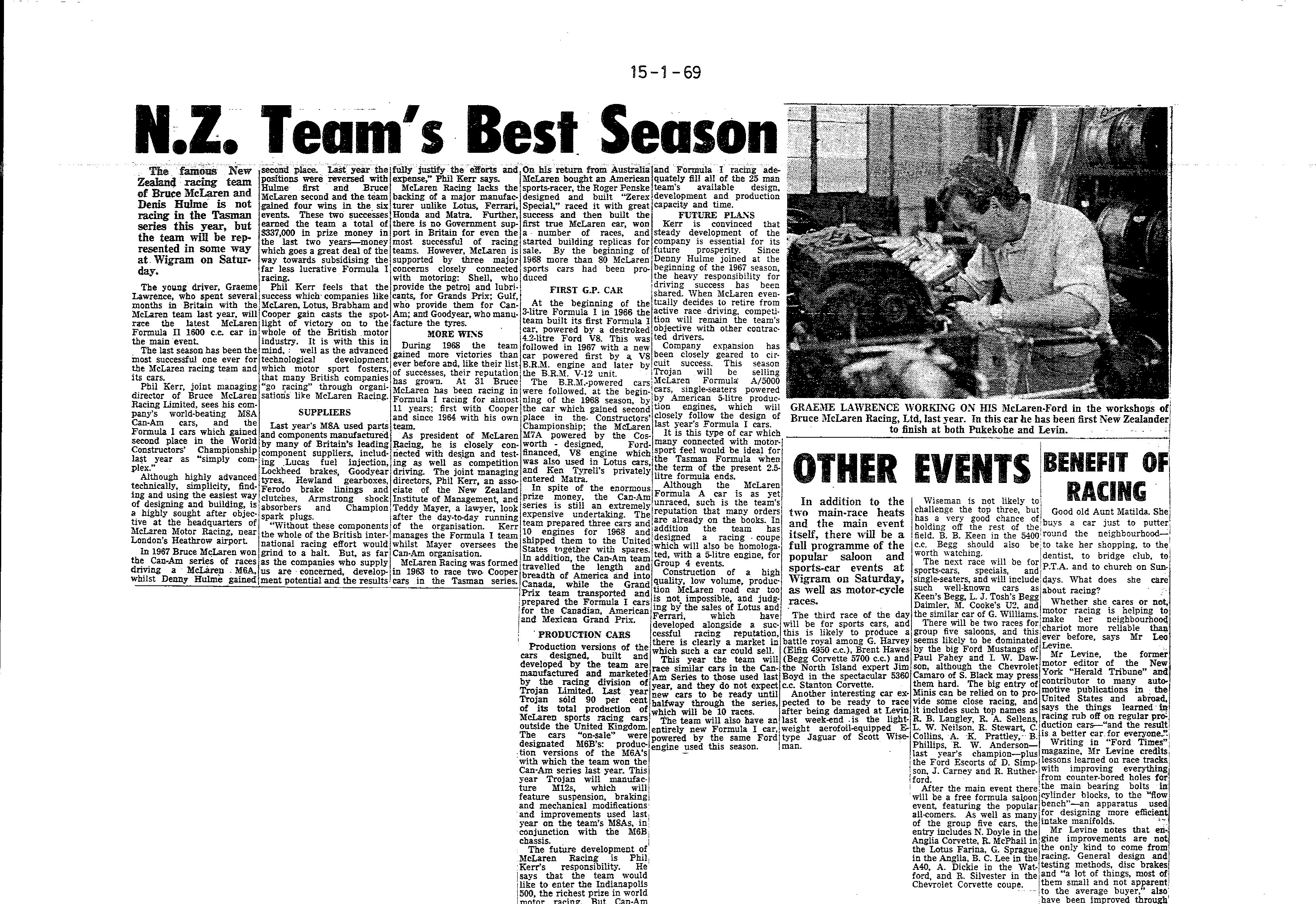
GRAŁME LAWRENCE WORKING ON HIS McLaren-Ford in the workshops of
Bruce McLaren Racing, Ltd, last year. In this car he has been first New Zealander
to finish at both Pukekohe and Levin.
OTHER
In addition to the
two main-race heats
and the main event
itself, there will be a
full programme of the
popular saloon and
sports-car events at
Wigram on Saturday,
as well as motor-cycle
races.
The third race of the day
will be for sports cars, and
this is likeiy to produce a
battle royal among G. Harvey
(Elfin 4950 c.c.), Brent Hawes
(Begg Corvette 5700 c.c.) and
the North Island expert Jim
Boyd in the spectacular 5360
c.c. Stanton Corvette.
Another interesting car expected to be ready to race
after being damaged at Levin
last week-end is the lightweight aerofoll equipped
type Jaguar of Scott Wiseman.
EVENTS BENEFIT OF
Wiseman is not likely to RACING
challenge the top three, but Good old Aunt Matilda. She
• a very good chance of
buys a car just to putter
holding of the rest of the
field. B. B. Keen in the 5400 round the neighbourhood-
C.C. Begg should also be to take her shopping, to the
worth watching. dentist, to bridge club, to
The next race will be for
sports-cars, speciais, and P.T.A. and to church on Sunsingle-seaters, and will include days. What does she care
such well-known cars as about racing?
Keen's Begg, L. J. Tosh's Begg Whether she cares or not,
Daimler, M. Cooke's U2, and is
the similar car of G. Williams. motor racing helping to
There will be two races fori make ber neighbourhood
group five saloons, and this Charlot more rellable than
seems likely to be dominated ever before, says Mr Leo
by the big Ford Mustangs of Levine.
Paul Fahey and I. W. Daw- Mr Levine, the former
son, altbough the Chevrolet motor editor of the New
York "Herald Tribune" and
Camaro of S. Black may press
them hard. The big entry of contributor to many auto!
Minis can be relied on to pro motive publications in: the
vide some close racing, and United States and abroad,
it includes such top names as says the things learned in
R. B. Langles, R. A. Sellens, racion choland fue result L. W. Neilson, R. Stewart, C.
Collins, A. K. „Prattley," B. is a better car for everyone." Writing in "Ford Times"
Philips, R. W. Andersonyear's champion-plusimagazine, Mr Levine credits
son. T Care and fister. lesson are eare racis
i ford. from counter-bored holes for
bolts in
will be a free foreveas then elinder blear, to the son event, featuring the popular bench"- an apparatus used
all-comers. As well as many for designing more efficient
of the group five cars, the intake manifolds.
entry includes N. Doyle in the Mr Levine notes that en-
Anglia Corvette, R. McPhail in gine improvements are not
the Lotus Farina, G. Sprague the only kind to come from in the Anglia, B. C. Lee in the racing. General design and
A40, A. Dickie in the Wat-testing methods, disc brakes
ford, and R. Silvester in the and "a lot of things, most of
Chevrolet Corvette coupe. them small and not apparent
to the average buyer, " also
have been improved through
Summaries and tables are machine-read from the scan and may contain errors: the scan is the record.