Read the OCR text
BIG CHANGES IN TYRES
Eighteen years ago ancing technique had to be $80,000 yeat on develop. solete when Dan Gurney use
the drivers ilt developed. ment moulds, the price would a set of Goodyear tyres wit
the
Lady Wigram Trophy Improved tyres have been be nearer $400 a tyre," Dun a 13.6in tread width to wi
chiefly responsible for ine lou's chief tyre development the June 15 Mosport, Ontari
Race would have raced startling increase in speeds at engineer (Mr 1. Mills) said|Canada, U.S.A.C.
tracks throughout the world. champion
on high-pressure tubed • recently. ship race.
tyres with treads Racing has now reached the At many European races Now the tyres Gurney use
point where tyres are He last 1yre coln- are obsolete. For racing tyre
only 4in wide. But on individual tracks, panies had five grades of tyres continue to grow in width i
Saturday they will each tyre being built to cope available, from with "very wet" to what will probably be a inas
run on tubeless Dun- specified condi- "wet, » "damp, or "dry" tyres. mum Slightly more tha
tions. But only a driver could de- 16in on the present wheels
lops, Firestones and Racing tyres are ex-cide which tyre to use, know-
Goodyears, with treads tremely, low. profile, and the ing lnal up lo 10sec a FIRESTONE
lap. The Firestone Tire
more than a foot wide, Tread widths can range up lo could be lost by using a wei.,
Ibin. Tread widths have weather tyre on a dry track. Rubber Company has part
and in most cases in- the advent of cipated in racing in
flated to only 16lb a more powerful DUNLOI United States for many year
sq. in. racing tyres, the cord angles Dunlop ClET hand the and since
are tower than those in con- tread patterns all. proto- Grand Prix field several year
The intense competition in ventional car tyres. and the types of racing tyres using a ago has had many
motor-racing has led to rapid tread pattern varies accord-special electrically - heated suceesses with its lyres.
changes and improvements in! ing to the type of racing foriknife. The knife cuts narrow European racing also.
dially antomotive parts and which the tyre is Intended. strips of rubber in "U" Because of the expense o
components-perhans none MANY TYPES shape exactly to the design maintaining racing pro
so inan iyres. For example, a de. pattern required. Firestone has
Track records have fallen signed for lIse t Le Mans the hand-cut tyres largely withdrawn frol
and mechanics where the weather may vary nave been fully lested and motor-racing, but is stil
have learned to take advan- from heavy ‚developed, a mould is madel providing iyres for some
tage of the increased bite the light mist within the 24 hours the Production can go ahcad. the overseas teams, and th
cars are getting from the pre-of the race, requires an of New Zealand branch of th
sent ultra-wide tyres. purpose tread pattern which. marking and cutting a tyre company still providin
But many problems had to is broken up enough to permit for use in formula d racing tyres for racing in New Zç
he solved in developing the drainage during heavy rain! takes up 1o four hours, and if land.
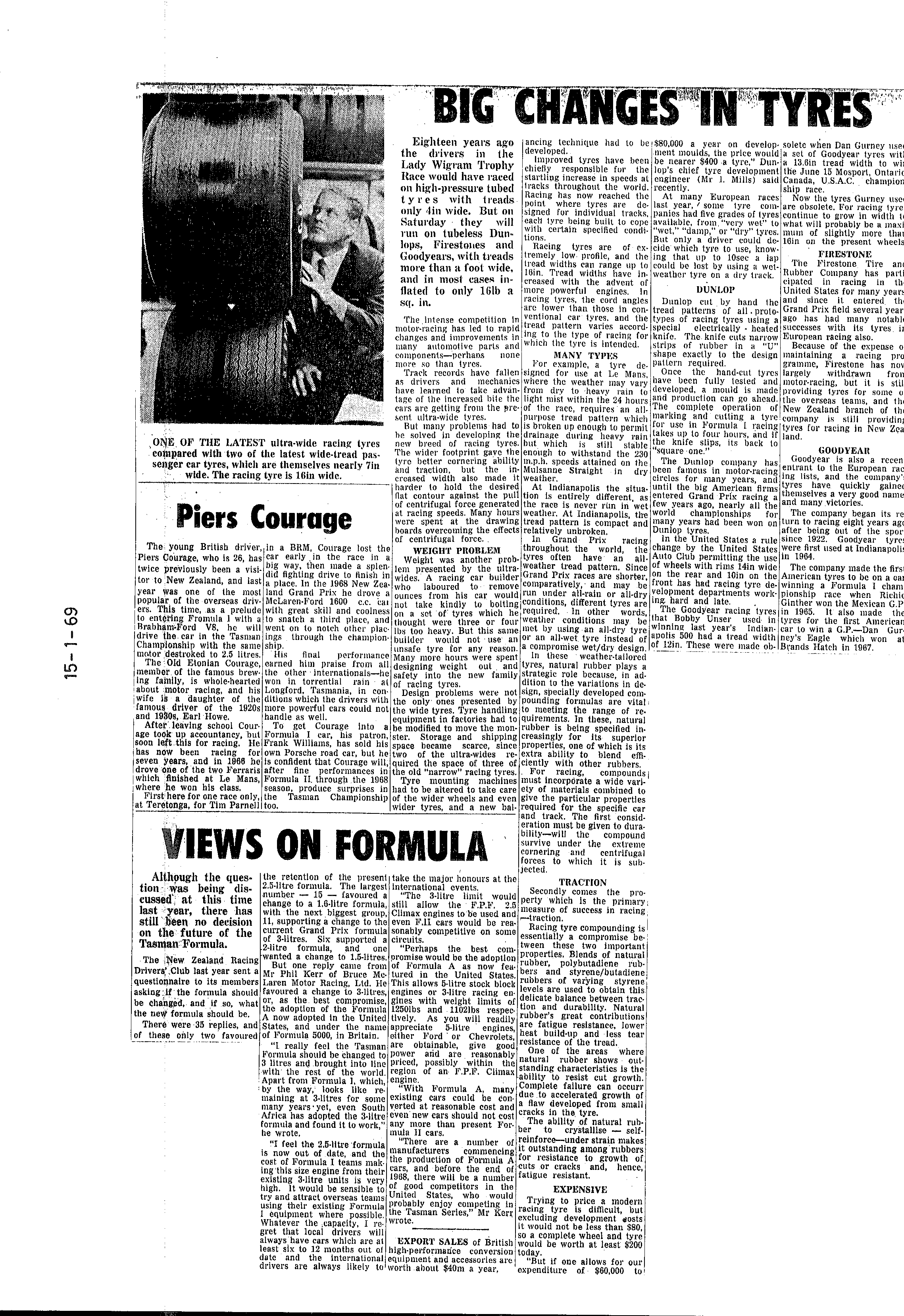
OND OF THE LATEST ultra-wide racing tyres new breed of racing tyres. but which stable: Ine knife back
compared with two of the latest wide-tread pas- The wider footprint gave the enough to withstand the 230 "square one." GOODYEAR
tyre better cornering ability in.p.h. speeds attained on the The Dunlop company Goodyear is also a recen
senger car tyres, which are themselves nearly 7in and traction, but the in- Mulsanne Straight been famous in motor-racing has entrant to the European rac
wide. The racing tyre is 16in wide. • in dry
creased width also made it weather. circles for years, and ing lists, and the company
harder lo hold the desired At Indianapolis the situa. until the big American firms! tyres have quickly LATES
nat contour against the pull tion is entirely different, as entered Grand Prix lacing themselves a very good name
of centrifugal force generated the race is never run wet! years ago, nearly all he and many victories.
at racing speeds. Many hours weather. At Indianapolis, the world championships for The company began its it
Piers Courage boards overcoming the effects relatively unbroken. were spent at the drawing tread pattern is compact and many years had been won on Duniop lyres. ¡turn to racing eight years ag after being Vult of the shor
of centrifugal force. Grand Prix racing i In the United States a rule since 1922. Goodyear tyre
The young British driver, in a BRM, Courage lost the WEIGHT PROBLEM throughout the world, the change by the Unitar. States, were first used at Indianapoli
Piers Courage, who is 26, has' car early in the race Weight was another prob- tyres often have all- Auto Club permitting the use 1964.
twice previously been a visi- big way, then made a splen lem presented by the ultra- weather tread pattern. Since of wheels with rims 14in wide The company made the firs
did fighting drive to finish in! wides. racing car builder; Grand Prix races are shorter, the rear and 10in on the American tyres to be on a oa
tor to New Zealand, and last a place. In the 1968 New Zea- who laboured to remove comparatively, and may be front has had racing tyre de- winning a Formula I Cucu
year, was one of the most land Grand Prix he drove from his would run under all-rain or all-dry velopment departments work- pionship race when Richi
popular of the overseas driv.! ounces
McLaren-Ford 1600 c.c. car not take kindly bolting conditions, different tyres are and late. Ginther won the Mexican G.P
er's. This time, as a prelude with great skill and coolness ULL set of tyres which required. other words, infine Goodyear racing tyres in 1965. It also
to entering Promula I with alto snatch a third place, and thought weather conditions that Bobby Unser used. in tyres for the fist
were three four
Brabham Ford V8, will went on to noten orner plac- too heavy. But this same using an all-dry tyre winning last year's Indian- car to win a G.P.-Dan
drive the car in the Tasman ings through the champion. builder would not use an or an all-wet tyre instead apolis 500 had a tread width ney's Eagle won
Champlonship with the same ship for any reason. a compromise wet/dry design. of 12in. These were made ob- Brands Hatch in 1967.
motor destroked to 2.5 litres. His final performance Many more hours were spent these weather-tailored
The Old Elonian Courage, earned him praise from all, weight VUL and tyres, natural rubber plays a
member of the famous brew. the designing
other internationals—he safety into the new family strategic role because, in ading tamily, 1S whole-hearted won torrential rain al of racing tyres. dition to the variations in deabout motor racing, and his Longlord, Tasmania. con- Design problems were not sign, specially developed comwife is daughter of the ditions which the drivers with the only ones presented pounding tormulas are vitali
famous driver of the 1920s more powerful cars could not the wide tyres. Tyre handling to meeting the range of re.
and 1930s, Earl Howe. handle as well. equipment in factories had to quirements. In these, natural
After leaving school Cour get Courage into a be niodified to move the mon- rubber is being specified inage took up accountancy, but Formula car, his patron, ster. Storage and shipping creasingly for Its superior
soon left this for racing. He Frank Williams, has sold his space became since properties, one of which is its
i bas now been racing forlown Porsche road car, but he two of the ultra-wides extra ability to blend emreseven years, and in 1966 hets confident that Courage will, quired the space of three of ciently with other rubbers.
drove one of the two Ferraris after fine performances in the old "narrow" racing tyres. For racing, compounds
which finished at Le Mans, Formula II. through the 1968 Tyre must incorporate a wide variwhere he won his class. season, produce surprises in had to be altered to take care ety of materials combined to
First here for one race only, the Tasman Championship of the wider wheels and even give the particular propertles
at Teretonga, for Tim Parnellitoo. wider tyres, and a new bal- required for the specific car
track. The first consideration must be given to durability—will the compound
VIEWS ON FORMULA survive under the extreme
cornering and centrifugal
forces to which it is subjected.
Although the ques- the retention of the present take the major honours at the
Z.á-litre formula. The largest international TRACTION
tion: was being dis- 15 events. Secondly the prothis time number - tavoured a 3-litre limit would
cussed, at change to a 1.6-litre formula, still the F.P.F. 2.5 perty which the primary:
last allow
year, there has with the next biggest group, Climax engines to be used and' measure of success in racing
still been no decision 11, supporting a change to the even FIl cars would be reaon the future of the current Grand Pris formula sonably competitive on some Racing tyre compounding is
of 3-litres. Six supported a circuits. essentially a compromise be-
Tasman Formula. 2-litre formula, and one "Perhaps the tween these tWo important
best com- propertles. Blends
The New Zealand Racing wanted a change to 1.5-litres. promise would be the adoption! of natural
one reply cane from of Formula as fed• rubber, and sybetad/ene rub-
Drivers' Club last year sent a Mr Phil Kerr of Bruce Me. tured the United States. bers styrene/butadiene
questionnaire to its members Ltd. He This allows 5-litre stock block rubbers of varying styrene,
Laren Motor Racing, levels are used to obtain this.
asking: If the formula should favoured a change to 3-litres, engines or 3-litre enbe changed, and if so, what O1, as the best compromise, with weight limits of delicate balance between trac.
the adoption of the Formula 1250lbs and . 11021bs tion and durability. Natural
respec.
the new formula should be. now adopted in the United tively. As you will readily rubber's great contributions
There were 35 replies, and States, and under the use ones are 0-11e engines, are fatigue resistance, loweri
of these only favoured of Formula 5000, in Britain. either Ford 01' heat build-up and less tear
Chevrolets,
"I really feel the Tasman are obtainable, give good, resistance of the tread. One of the alway where
Formula shouid be changed to power arid are reasonably
natural rubber shows out-
3 litres and brought into line pricel, possibly within the standing characteristics is thei
with the rest of the region of an F.P.F. Climax
lability to resist cut growth.
Apart from Formula I, which, engine.
: by the way. UUKo "With Formula Complete failure can occurr
Abe many! due to accelerated growth of
maining at 3-litres for some existing cars could
any years yel even South verted at reasonable cost and a flaw developed from small cracks in the tyre.
Africa has adopted the 3-iltre even new cars should not cost The ability of natural rub
formula and found it to work, " any more than present for ber
he wrote. mula II cars. crystallise - self-
"I feel the 2.5-Iltre formula "There of reinforce-under strain makes
is now out of date, and the manufacturets te placturion of omencing for esindice to someon
cost of Formula I teans mak- resistance to
ing this size engine from their cars, and before the end of cuts or and, hence,
existing 3-litre 1968, there will be a number fatigue resistant.
is very
high. It would be sensible to of good competitors in the EXPENSIVE
try and attract overseas teams , United States, who would
their probably enjoy competing in modern
existing Formula racing. tyre difficult, but
ecuipment possible. the Tasman Series,' Mr Kerr
I wrote. excluding development gosts
Whatever the capacity, I it would not be less than $80,
gret that local so a complete wheel and tyre
always have cars which are at EAPORT SALES of British would be worth at least $200
least six to 12 months out of high-performance conversion today.
date and the International equipment and accessories are
drivers are always "But if one allows for our
likely to worth about $40m a year, expenditure $60,000
to i
Summaries and tables are machine-read from the scan and may contain errors: the scan is the record.