Wigram TrophyMotor racing at Wigram airfield · Christchurch · 1949–2000
Home › Archive › 1969 › Safety of drivers is their job
← 14 Jan 1969All 1969 pages15 Jan 1969 →
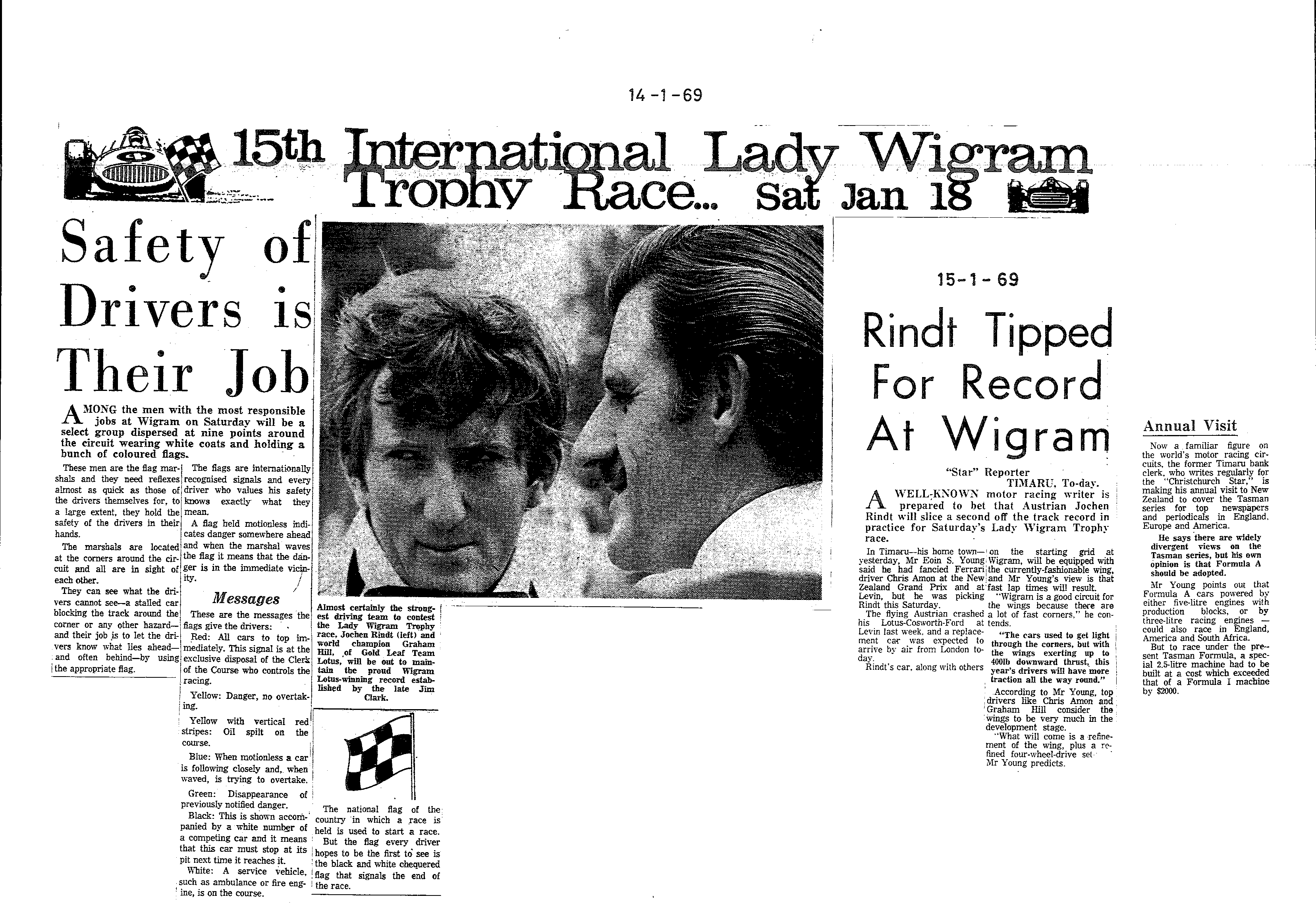
Scan of the clipping page, 14 January 1969
↗
Drag to move · scroll or pinch to zoom
feature

Safety of drivers is their job

Explains the role of the flag marshals stationed at nine points around the Wigram circuit for the 15th International Lady Wigram Trophy race, and the meaning of each flag colour. Jochen Rindt and world champion Graham Hill of the Gold Leaf Team Lotus are named as the strongest driving team, out to maintain Lotus's Wigram winning record set by the late Jim Clark.

Facts

  • Flag marshals were stationed at nine points around the Wigram circuit for the 1969 Lady Wigram Trophy meeting, all in sight of each other.
  • A motionless yellow flag means danger ahead; a waved yellow means danger in the immediate vicinity; yellow with red stripes means oil on the course.
  • A red flag means all cars must stop immediately, and is at the exclusive disposal of the Clerk of the Course.
  • A black flag with a white car number means that car must stop at its pit next time round; a white flag means a service vehicle is on the course.
  • The national flag of the country hosting a race is used to start it; the black and white chequered flag ends it.
preview · Christchurch Star

Rindt tipped to set record at Wigram

Motor racing writer Eoin S. Young, in his home town of Timaru, predicted Jochen Rindt would cut a second off the Wigram track record in practice for the Lady Wigram Trophy. Rindt had crashed his Lotus-Cosworth-Ford at Levin and a replacement car was due by air from London. Young also discussed the effect of wings on the cars and argued for Formula A to replace the Tasman Formula.

Facts

  • Cars at the 1969 Lady Wigram Trophy were to be fitted with wings, exerting up to 400lb of downward thrust.
  • Eoin Young said a special 2.5 litre Tasman Formula machine cost $2000 more to build than a Formula 1 car.
  • Jochen Rindt crashed his Lotus-Cosworth-Ford at Levin in January 1969 and a replacement was flown from London.
Read the OCR text
14-1-69 15th Inter Trop national hy Race. Lady Sat Safety of Drivers is Their Job AMONG the men with the most responsible jobs at Wigram on Saturday will be a seleci group dispersed at nine points around Ine circut wearing white coats and holding a bunch of coloured flags. These men are the flag mar- The fags are internationally shals and they need reflexes recognised signals and every almost as quick as those of driver who values his safety the drivers themselves for, to knows exactly what a large extent, they hold the mean. safety of the drivers in their A flag held motionless indihands. cates danger somewhere ahead The marshals are located and when the marshal waves at the corners around the cir- the flag it means that the dan cuit and all are in sight of ger is in the immediate vicin each other. They can see what the drivers cannot see-a stalled car Messages blocking the track around the Almost certainly the strong- These are the messages the est driving team to contest corner or any other hazard- flags give the drivers: • the Lady Wigram Trophy and their job is to let the dri- Red: All cars to top im- race, Jochen Rindt (left) and vers know what lies ahead— world champion Graham - mediately. This signal is at the Hill, ‚oF Gold Leaf Team and often behind-by using exclusive disposal of the Cler's Lotus, will be out to mainthe appropriate flag. of the Course who controls the tain proud Wigram racing. Lotus-winning record established by the late Jim Yellow: Danger, no overtak- Clark. ing. Yellow with vertical red! stripes: Oil spilt on the course. Blue: When motionless a car is following closely and, when waved, is trying to overtake. Green: Disappearance of previously notifed danger. The national flag of the Black: This is shown accom country in which a race is panied by a white number of held is used to start a race. a competing car and it means But the flag every driver that this car must stop at its hopes to be the first to see is pit next time it reaches it. the black and white chequered White: A service vehicle, flag that signals the end of • such as ambulance or fire eng- the race. : ine, is on the course. • Wigram Jan 18 15-9-69 Rind Tippea For Record At Wigram "Star" Reporter TIMARU, To-day. WELL-KNOWN motor racing writer is A prepared to bet that Austrian Jochen Rindt will slice a second off the track record in practice for Saturday's Lady Wigram Trophy race. In Timaru-his home townyesterday, Mr Eoin S. Young said he had fancied Ferrari driver Chris Amon at the New Zealand Grand Prix and at Levin, but he was picking Rindt this Saturday. The flying Austrian crashed his Lotus-Cosworth-Ford at Levin last week, and a replacement car was expected to arrive by air from London today. Rindt's car, along with others - on the starting grid Wigram, will be equipped with the currently-fashionable wing, and Mr Young's view is that fast lap times will result. "Wigram is a good circuit for the wings because there are a lot of fast corners, ," he con- : tends. "The cars used to get light through the corners, but with the wings exerting up to 400ib downward thrust, this year's drivers will have more traction all the way round." According to Mr Young, top drivers like Chris Amon and Graham Hill consider the wings to be very much in the development stage. "What will come is a refinement of the wing, plus a refined four-wheel-drive set: Mr Young prediets. Annual Visit Now a familiar figure on the world's motor racing circuits, the former Timaru bank clerk, who writes regularly tor the "Christchurch Star, making his annual visit to New Zealand to cover the Tasman series for top newspapers and periodicals in England. Europe and America. He says there are widely divergent views the Tasman series, but his own opinion is that Formula A should be adopted. Mr Young points out that Formula A . cars powered by either five-litre engines with production blocks, or by three litre racing engines could also race in England, America and South Africa. But to race under the present Tasman Formula, a special 2.5 litre machine had to be built at a cost which exceeded that of a Formula I machine by $2000.

Summaries and tables are machine-read from the scan and may contain errors: the scan is the record.