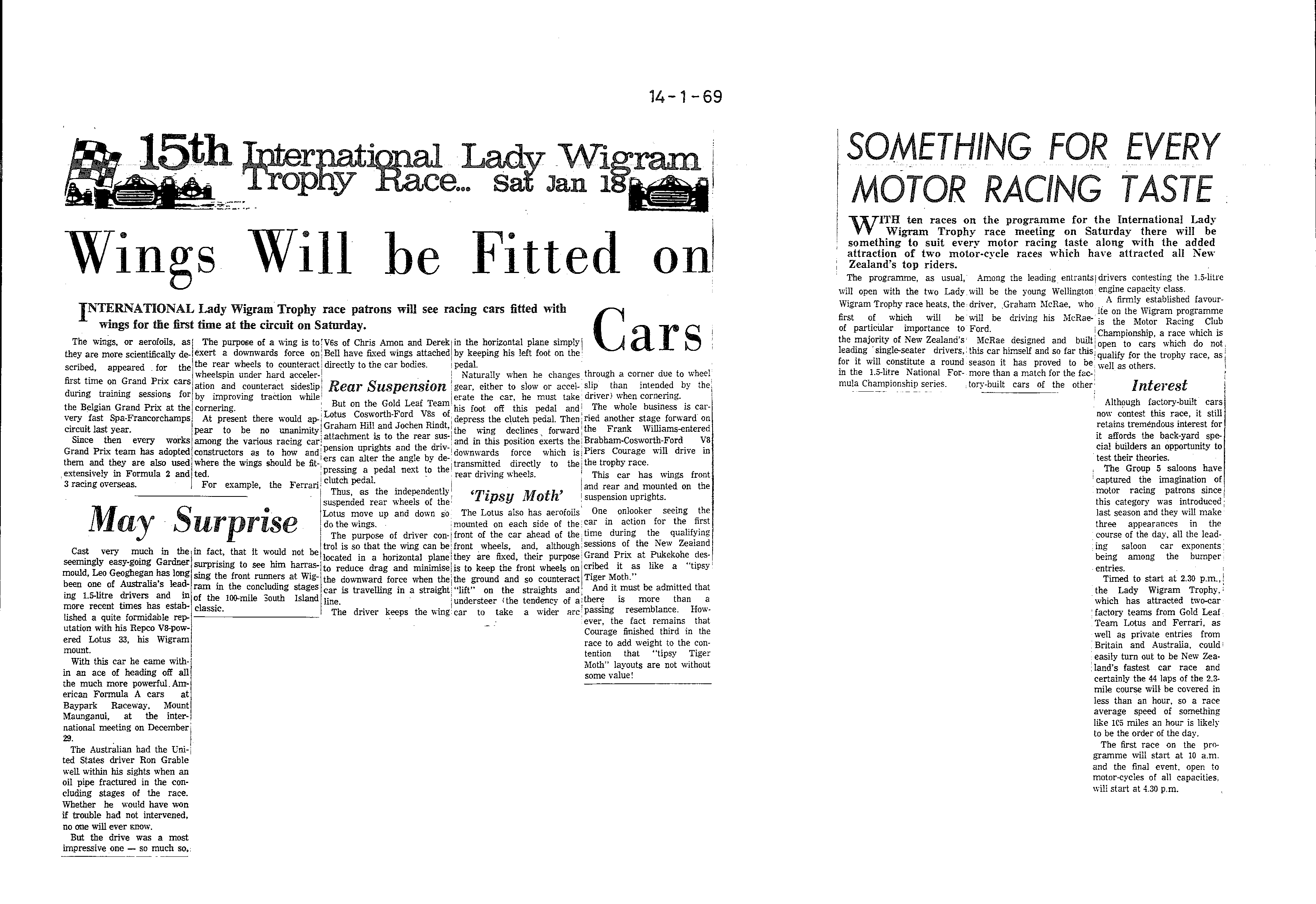
featureWings will be fitted on racing cars
Explains the aerofoil wings that Wigram patrons would see for the first time at the 1969 Lady Wigram Trophy. Introduced at Spa in 1968, they press the rear wheels down for traction. Amon's and Bell's Ferraris have fixed body-mounted wings; the Gold Leaf Team Lotuses of Hill and Rindt have driver-adjustable wings on the rear suspension uprights; and Piers Courage's Williams Brabham-Ford has front and rear wings, nicknamed the 'tipsy Tiger Moth'. It also profiles Australian Leo Geoghegan, whose Repco V8 Lotus 33 nearly beat the American Formula A cars at Baypark in December.
Facts
- Aerofoil wings first appeared on Grand Prix cars in practice for the 1968 Belgian Grand Prix at Spa-Francorchamps and were fitted to every works Grand Prix team by 1969.
- At the 1969 Lady Wigram Trophy the Lotus wings were attached to the rear suspension uprights and adjusted by a pedal next to the clutch.
Photos
- Racing cars with 'wings' will be seen for the first time at Wigram on Saturday. The Frank Williams-entered Brabham-Cosworth-Ford V8, driven by Piers Courage, has wings front and rear and has been labelled the 'tipsy Tiger Moth' by one commentator.
previewSomething for every motor racing taste
Overview of the ten-race 1969 Lady Wigram programme: the first Lady Wigram Trophy heat was the 1.5-litre National Formula championship round (including Wellington's Graham McRae in his own-design McRae), the Motor Racing Club Championship for back-yard specials, three Group 5 saloon appearances and two motor-cycle races. The 2.30 pm trophy race of 44 laps was expected to be New Zealand's fastest car race.
Facts
- The first Lady Wigram Trophy heat in 1969 counted as a round of the 1.5-litre National Formula Championship.
- The 1969 Lady Wigram Trophy attracted two-car factory teams from Gold Leaf Team Lotus and Ferrari plus private entries from Britain and Australia.
Read the OCR text
14-1-69
15th
international
1rophy I Race.
Lady Wigram
Sat Jan 18
Wings
Will be
INTERNATIONAL Lady Wigram Trophy race patrons will see ra
wings for the first time at the circuit on Saturday.
The wings, or aerofoils, as
they are more scientifically described, appeared for the
first time on Grand Prix cars
during training sessions for
the Belgian Grand Prix at the
very fast Spa-Francorchamps
circuit last year.
Since then every works
Grand Prix team has adopted
them and they are also used
extensively in Formula 2 and
3 racing overseas.
May S
Cast very much in the
seemingly easy-going Gardner
mould, Leo Geoghegan has long|
been one of Australia's leading 1.5 litre drivers and in
more recent times has established a quite formidable reputation with his Repco V8-powered Lotus 33, his Wigram
mount.
With this car he came with-!
in an ace of heading off all
the much more powerful. Am-!
erican Formula A cars at!
Baypark Raceway, Mount
Maunganui, at the inter-i
national meeting on December
29.
The Australian had the Uni-i
ted States driver Ron Grable
well within his sights when an
oil pipe fractured in the concluding stages of the race.
Whether he would have won
if trouble had not intervened,
no one will ever know.
But the drive was a most
impressive one - so much so,:
The purpose of a wing is to
¡exert a downwards force on
the rear wheels to counteract
wheelspin under hard acceleration and counteract sideslip
by improving traction while
cornering.
At present there would appear to be no unanimity
among the various racing car
constructors as to how and
where the wings should be fitted.
For example, the Ferrari
urprise
in fact, that it would not be
surprising to see him harrassing the front rumers at Wigram in the concluding stages
of the 100-mile South Island
classic.
V6s of Chris Amon and Derek
Bell have fixed wings attached
directly to the car bodies.
Rear Suspension
But on the Gold Leat Team
Lotus Cosworth-Ford V8s of
Graham Hill and Jochen Rindt,
attachment is to the rear suspension uprights and the drivers can alter the angle by depressing a pedal next to the
clutch pedal.
Thus, as the independently
suspended rear wheeis of the
Lotus move up and down so
do the wings.
The purpose of driver control is so that the wing can be
located in a horizontal plane
to reduce drag and minimise
the downward force when the
car is travelling in a straight
line.
The driver keeps the wing
Fitted on
acing cars fitted with
in the horizontal plane simply
by keeping his left foot on the
pedal.
Naturally when he changes
gear, either to slow or accelerate the car, he must take
his foot off this pedal and
depress the clutch pedal. Then
the wing declines forward
and in this position exerts the
downwards force which is
transmitted directly to the
rear driving wheels.
•Tipsy Moth
'he Lotus also has aerof
mounted on each side of the
front of the car ahead of the
front wheels, and, although
they are fixed, their purpose
is to keep the front wheels on
the ground and so counteract
"lift" on the straights and
understeer (the tendency of a
car to take a wider are
Cars
through a corner due to wheel
slip than intended by the
driver) when cornering.
The whole business is carried another stage forward on
the Frank Williams-entered
Brabham-Cosworth-Ford V8
Piers Courage will drive in
the trophy race.
This car has wings front
and rear and mounted on the
suspension uprights.
One onlooker seeing the
car in action for the first
time during the qualifying
sessions of the New Zealand
Grand Prix at Pukekohe described it as like a "tipsy
Tiger Moth."
And it must be admitted that
there is more than a
passing resemblance. However, the fact remains that
Courage finished third in the
race to add weight to the contention that "tipsy Tiger
Moth" layouts are not without
some value!
SOMETHING FOR
EVERY
MOTOR
Wilk ten races o • Wigram Troph
something to suit ever
attraction of two mot
Zealand's top riders.
The programme, as usual,
will open with the two Lady.
Wigram Trophy race heats, the
first of which will be
of particular importance to
the majority of New Zealand's'
leading single-seater drivers,
for it will constitute a round
in the 1.5-litre National For-
ula Championship seri
RACING
TASTE
on the programme for the International Lady
y race meeting on Saturday there will be
ry motor racing taste along with the added
tor-cycle races which have attracted all New
Among the leading en
will be the young Wellir
driver, Graham MeRae,
will be driving his Mc
Ford.
McRae designed and
this car himself and so far
season it has proved to
more than a match for the
tory-built cars of the r
rants| drivers contesting the 1.5-litre
ngton engine capacity class.
who A firmly established favourite on the Wigram programme
cRae- Club
is the Motor Racing
Championship, a race which is
built open to cars which do not
* this qualify for the trophy race, as
o be well as others.
e facother Interest
Although factory-built cars
now contest this race, it still
retains tremendous interest for
it affords the back-yard spe
cial builders an opportunity to
test their theories.
The Group 5 saloons have
captured the imagination of
motor racing patrons since
this category was introduced
last season and they will make
three appearances in the
course of the day, all the leading saloon car exponents
being among the bumper
entries.
Timed to start at 2.30 p.m.,
the Lady Wigram Trophy,
which has attracted two-car
factory teams from Gold Leaf:
Team Lotus and Ferrari, as
• well as private entries from
Britain and Australia, could!
easily turn out to be New Zea-
: land's fastest car race and
certainly the 44 laps of the 2.3mile course will be covered in
less than an hour, so a race
average speed of something
like 165 miles an hour is likely
to be the order of the day.
The first race on the programme will start at 10 a.m.
and the final event, open to
motor-cycles of all capacities:
Will start at 4.30 p.m.
Summaries and tables are machine-read from the scan and may contain errors: the scan is the record.