news · Sydney Daily TelegraphGrand Prix courses are under fire
Australian team manager David McKay, quoted in the Sydney Daily Telegraph, attacked the organisation at Pukekohe and Levin: he said Australians were way ahead of New Zealand, criticised the clerk of the course directing from the infield, practice timetables not followed, no marshal at the signalling pits and the rough Levin track, and blamed the Association of NZ Car Clubs for issuing permits.
Facts
- David McKay criticised the organisation of the 1966 NZ Grand Prix at Pukekohe and the Levin international, saying Levin had been running for more than ten years.
- A first Tasman practice at Levin in January 1966 was called off because Clark and the BRM team were not ready.
previewMotor-cycle stars for city events
Preview of the two motor-cycle events at the 1966 Lady Wigram meeting, with a record entry: Hugh Anderson (Suzuki), visiting Ginger Malloy (Bultaco), Brian Scobie (Norton, captain of the NZ Isle of Man team), Tommy McCleary jun. (Norton), Neville Landreth (who had beaten Anderson at Pukekohe and Levin), Kevin McCleary (Greeves), Don Damiano and Johnny Hubbard.
Facts
- The 1966 Lady Wigram meeting had a record entry in its two motor-cycle events.
featureJackie Stewart profile
Profile of Jackie Stewart (given as 25 in other articles) from Dumbarton, tipped as a future world champion: Tyrrell Formula 3 in 1964 (11 international wins), BRM number two to Graham Hill in 1965, third in the world championship. Early racing in a Marcos GT in 1961 was anonymous because of parental opposition; Denis Jenkinson praised him as a natural high-speed driver.
Facts
- Jackie Stewart won 11 international Formula 3 events in 1964 with the Tyrrell team and finished third in the 1965 world championship.
- In the 1965 season Stewart finished sixth in South Africa, won the Silverstone International Trophy, third at Monte Carlo and second at Spa, French and Dutch GPs.
featureSpencer Martin profile
Profile of 25-year-old Australian Spencer Martin of Scuderia Veloce (David McKay): started with a home-built fibreglass sports car, won 12 of 16 saloon races in a Holden in 1962, drove a Repco Brabham from the end of 1963, was Graham Hill's mechanic in the 1964 and 1965 Tasman races and won the NSW road racing championship in 1965. He first raced in NZ at Pukekohe in 1966, qualifying on the front row before spinning out on lap one.
Facts
- Spencer Martin won the 1965 NSW road racing championship, Governors' Trophy and Queensland Tourist Trophy.
- Martin scored 12 wins and two seconds in 16 saloon starts in a Holden in 1962.
Photos
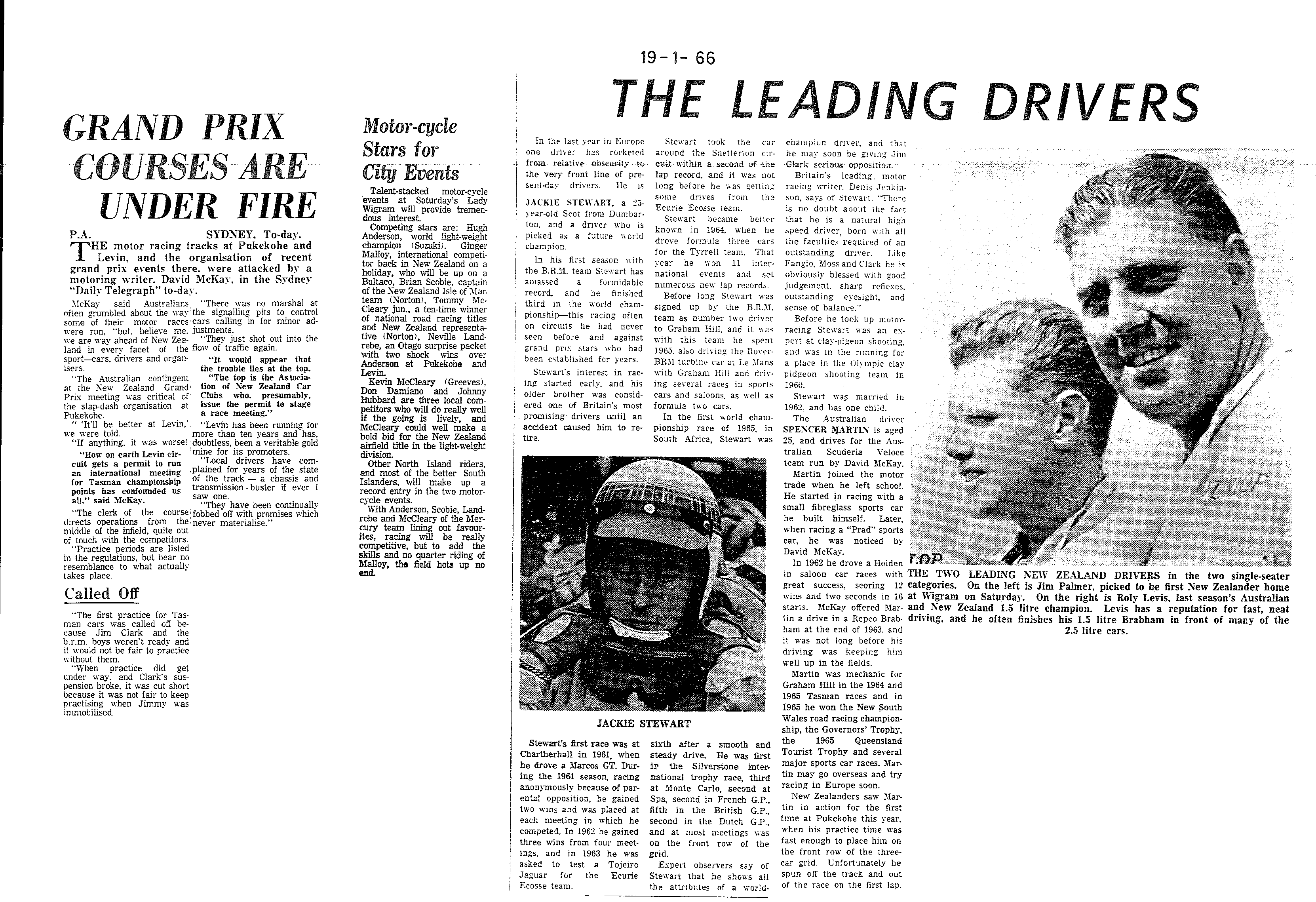
- The two leading New Zealand drivers in the two single-seater categories. On the left is Jim Palmer, picked to be first New Zealander home at Wigram on Saturday. On the right is Roly Levis, last season's Australian and New Zealand 1.5 litre champion. Levis has a reputation for fast, neat driving, and he often finishes his 1.5 litre Brabham in front of many of the 2.5 litre cars.
Read the OCR text
19 - 1-66
GRAND
PRIX
COURSES ARE
UNDER
FIRE
P.A.
THe motor ra Levin, and
grand prit event
motoring writer.
"Daily Telegraph"
SYDNEY. To-day.
cing tracks at Pukekohe and
the organisation of recent
is there. were attacked by a
David MeKay. in the Sydney
'to-day.
Mckay said Australians
often grumbled about the was
some of their motor races
were run. "but. believe me,
we are way ahead of New Zealand in every facet of the
sport-cars, drivers and organisers.
"The Australian contingent
at the New Zealand Grand
Prix meeting was critical of
the slap-dash organisation at
Pukekone.
"It'll be better at Levin,'
we were toid
"If anything. it was worse!
"How on earth Levin circuit gets a permit to run
an international meeting
for Tasman championship
points has confounded us
all." said MeKay.
"The clerk of the course
directs operations from the
middle of the infield, quite out
of touch with the competitors.
"Practice periods are listed
in the regulations, but bear no
resemblance to what actually
takes place.
"There was no marshal at
the signalling pits to control
cars calling in for minor adjustments.
''They just shot out into the
fiow of traffic again.
"It would appear that
the trouble lies at the top.
"The top is the Association of New Zealand Car
Clubs who. presumably.
issue the permit to stage
a race meeting."
"Levin has been running for
more than ten years and has,
doubtless, been a veritable gold
mine for its promoters.
"Local drivers have complained for years of the state
of the track - a chassis and
transmission - buster if ever I
saw one.
"They have been continually
! fobbed off with promises which
• never materialise.
Called Off
"The first practice for Tasman cars was called off because Jim Clark and the
b.r.m. boys weren't ready and
it would not be fair to practice
without them.
"When practice did get
under way. and Clark's suspension broke, it was cut short
because it was not fair to keep
practising when Jimmy was
immobilised.
Motor-cycle
Stars for
City Events
Talent-stacked motor-cycle
events at Saturday's Lady
wigram will provide tremendous interest.
Competing stars are: Hugh
Anderson, world light-weight
champion (Suzuki). Ginger
Malloy, international competitor back in New Zealand on a
holiday, who will be up on a
Bultaco, Brian Scobie, captain
of the New Zealand Isle of Man
team (Norton), Tommy Mc-
Cleary jun., a ten-time winner
of national road racing titles
and New Zealand representative (Norton), Neville Landrebe, an Otago surprise packet
with two shock wins over
Anderson at Pukekohe and
Levin.
Kevin McCleary (Greeves),
Don Damiano and Johnny
Hubbard are three local competitors who will do really well
if the going is lively, and
McCleary could well make a
bold bid for the New Zealand
airfield title in the light-weight
division.
Other North Island riders.
and most of the better South
Islanders, will make up a
record entry in the two motorcycle events.
With Anderson, Scobie, Landrebe and McCleary of the Mercury team lining out favourites, racing will be really
competitive, but to add the
skills and no quarter riding of
Malloy, the field hots up zo
end.
in the last year in Euros
Stewart took the
one driver has rocketed around the Snetterton cirfrom reiative obscurity to cuit within a second of the
the very front line of pre- lap record, and it was not
sent-day drivers.
long before he was getting
JACKIE STEWART, a 35year-old Scot from Dumbarton. and a driver who is
picked as a future world
champion.
In his first season with
the B.R.. team Stewart has
some drives îrcin the
Ecurie Ecosse team.
tewart became
known in 1964. when he
drove formula three cars
for the Tyrrell team. That
wear he won 11 international events and set
amassed a formidable
record, and he finished
third in the world championship-this racing often
on circuits he had never
seen before and against
numerous new lap records.
Before long Stewart was
signed up by the B.R.MI.
tean as number two driver
to Graham Hill, and it was
with this team he spent
grand prix stars who had
been established for yea
Stewart's interest in racing started early. and his
older brother was consid-
1965. alo driving the Rover
BRI turbine car at Le Man:
with Graham Hill and driv
ing several races in sport
cars and saloons, as well a
ered one of Britain's most formula iwo cars.
promising drivers until an In the first world chamaccident caused him to re pionship race of 1965, in
tire. Sour
Africa, Stewart was
JACKIE STEWART
Stewart's first race was at
Chartherball in 1961, when
be drove a Marcos GT. During the 1961 season, racing
anonymously because of parental opposition, be gained
two wins and was placed at
each meeting in which he
competed. In 1962 he gained
three wins from four meetings, and in 1963 he was
asked to test a Tojeiro
Jaguar for the Ecurie
Ecosse team.
sixth aiter a smooth and
steady drive. He was first
ir the Silverstone international trophy race, third
at Monte Carlo, second at
Spa, second in French G.P.,
fifth in the British G.P.,
second in the Dutch G.P.,
and at most meetings was
on the front row of the
grid.
Expert observers say of
Stewart that he shows all
the attributes of a world-
ADING
DRIVERS
champion d.
he mat soon be giving Jim
Clark serious opposition:
Britain's leading. motor
racing writer. Denis Jenkinson, says of Stewart: "There
is no doubt about the fact
that he is a natural high
speed driver, born with all
the faculties required of an
outstanding driver. Like
Fangio, Moss and Clark he is
obviously blessed with good
judgement. sharp refiexes,
outstanding eyesight, and
sense of balance."
Before he took up motorracing Stewart was an expert at clay-pigeon shooting,
and was in the running for
a place in the Olympic clay
pidgeon shooting teamn in
1960.
Stewart was married in
1962, and has one child.
The Australian driver
SPENCER MARTIN is aged
25, and drives for the Australian Scuderia Veloce
team run by David NIcKay.
Martin joined the motor
trade when he left school.
He started in racing with a
small fibreglass sports car
he built himself. Later,
when racing a "Prad" sports
car, was noticed by
David McKay.
In 1962 he drove a Holden
in saloon car races with
great success, scoring 12
wins and two seconds in 16
starts. Mckay offered Martin a drive in a Repco Brab.
ham at the end of 1963, and
it was not long before his
driving was keeping him
well up in the fields.
Martin was mechanic for
Graham Hill in the 1964 and
1965 Tasman races and in
1965 he won the New South
Wales road racing championship, the Governors' Trophy,
the 1965 Queensland
Tourist Trophy and several
major sports car races. Martin may go overseas and try
racing in Europe soon.
New Zealanders saw Martin in action for the first
tune at Pukekohe this year,
when his practice time was
fast enough to place him on
the front row of the threecar grid. Unfortunately he
spun off the track and out
of the race on the first lap.
гор
THE TWO LEADING NEW ZEALAND DRIVERS in the two single-seater
categories. On the left is Jim Palmer, picked to be first New Zealander home
at Wigram on Saturday. On the right is Roly Levis, last season's Australian
and New Zealand 1.5 litre champion. Levis has a reputation for fast, neat
driving, and he often finishes his 1.5 litre Brabham in front of many of the
2.5 litre cars.
Summaries and tables are machine-read from the scan and may contain errors: the scan is the record.