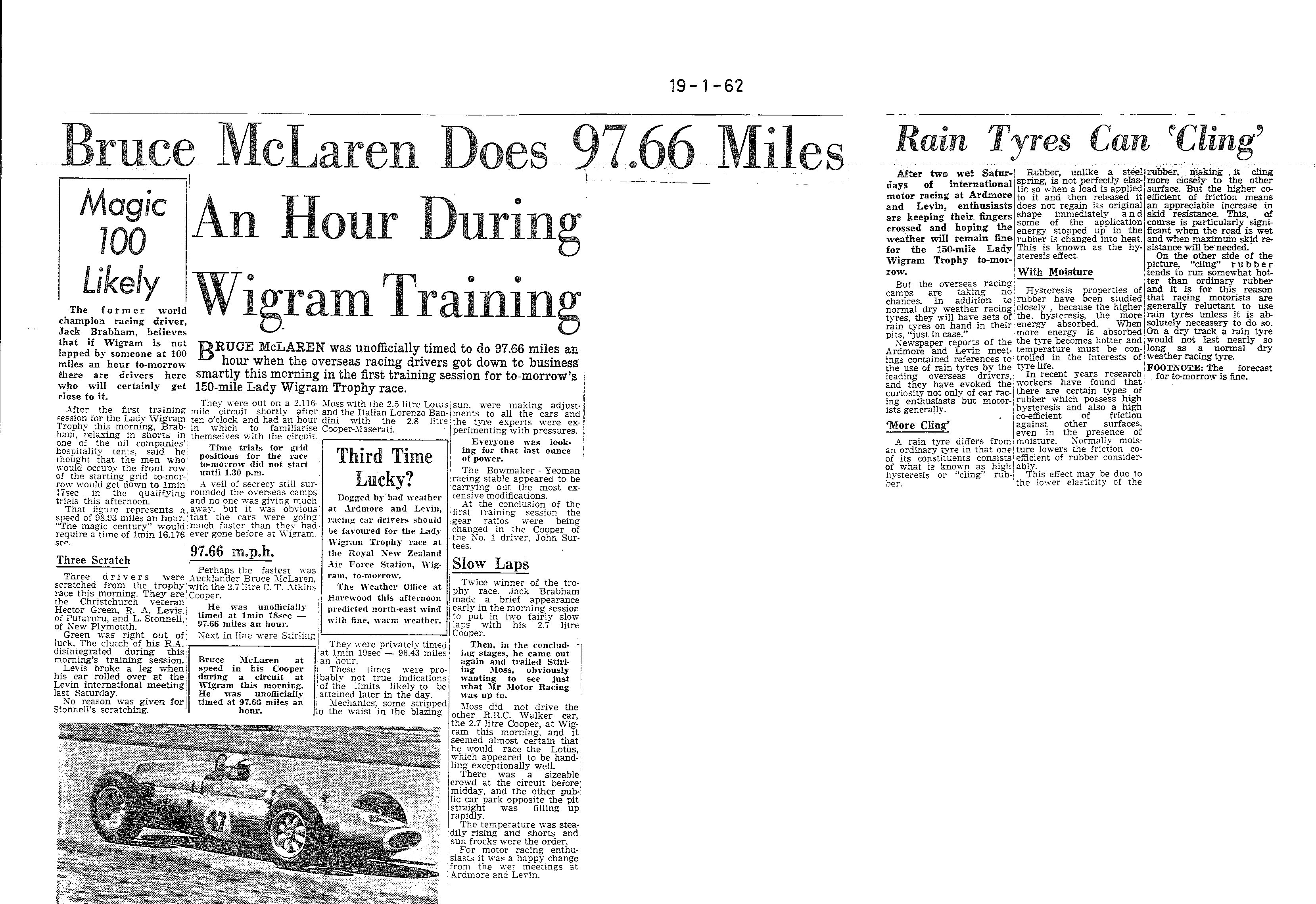
race reportBruce McLaren does 97.66 mph in Wigram training
Bruce McLaren was unofficially timed at 1:18 (97.66 mph) in the first training session for the 1962 Lady Wigram Trophy, with Moss's Lotus and Bandini's Cooper-Maserati privately timed at about 1:19 (96.43 mph). Brabham, who made two slow laps then trailed Moss, predicted the magic 100 mph lap, which needs 1:16.176, would be close. Hec Green, R. Levis and L. Stonnell were scratched.
Lap times
- Bruce McLaren (2.7 litre Cooper): 1:18 practice
- Stirling Moss (2.5 litre Lotus): 1:19 practice
- Lorenzo Bandini (2.8 litre Cooper-Maserati): 1:19 practice
- : 1:16.176 other
Facts
- Bruce McLaren was unofficially timed at 97.66 mph (1:18) in the first training session for the 1962 Lady Wigram Trophy.
- A 100 mph lap of Wigram's 2.116-mile circuit required a time of 1:16.176.
- Hec Green, R. A. Levis and L. Stonnell were scratched from the 1962 Lady Wigram Trophy on practice day; Levis broke a leg at Levin and Green's R.A. clutch disintegrated.
- Time trials for grid positions for the 1962 Lady Wigram Trophy did not start until 1.30pm on Friday January 19.
- The 1962 meeting followed wet international meetings at Ardmore and Levin; overseas teams brought rain tyres to Wigram just in case.
featureRain tyres can 'cling'
Explains how rain tyres use high-hysteresis 'cling' rubber for better grip on wet roads but run hotter and wear faster on a dry track, so racing drivers avoid them unless needed.
Read the OCR text
19-9-62
Bruce
McLaren
Does 9
Magic
100
An Hour
During
Likely
champion Jack The Brabham, believes former world racing driver, Wigram Training
that if Wigram is not
lapped by someone at 100 BRUCE MCLAREN was unofficially timed to do 97.66 miles an
miles an hour to-morrow hour when the overseas racing drivers got down to business
ehere are drivers here smartly this morning in the first training session for to morrow's
who will certainly get 150-mile Lady Wigram Trophy race.
close te it.
They were out on a 2.116- • Hoss with the 2.5 litre Lotus|sun, were making adjusttraining mile shortly after and the Italian Lorenzo Ban-merits to all the cars and
session for the Lady Wigram ten o'clock and had an hour dini 2.8 litre the tyre experts were ex-
Trophy this morning, Brab- in familiarise Cooper-Maserati. perimenting with pressures.
ham, relaxing in shorts in themselves with the circuit.
companies': Everyone mas look•
Time trials for grid ing for that last ounce
hospitality tents, said positions for the race Third Time
thought that the men who of power.
to-morrow did not start
would occupy the front row The Bowmaker - Yeoman
of the starting grid to-mor- until 1.30 p.m.
row would get down to 1min A veil of secrecy still sur- Lucky? racing stable appeared to be carrying out the most exqualifying rounded the overseas camps tensive modifications.
trials this afternoon. and no one was giving much Dogged by bad weatber
At the conclusion . of the
That figure represents a. away, but it was obvious at Ardmore and Levin, first training session the
speed of 98.93 miles an hour. the cars were going racing car drivers should ratios were
"The magic century" would much faster than ther had gear being
be favoured for the Lady changed in the Cooper of
require a time of 1min 16.176 ever gone before at Wigram. the No. I driver, John Sur-
Wigram Trophy race at tees.
97.66 m.p.h. the Royal New Zealand
Three Scratch Slow Laps
Perhaps the fastest was Air Force Station, Wig-
Three arivers were Aucklander Bruce licLaren, ram, to-morrow.
scratched from the trophy with the 2.7 litre C. I. Atkins The Weather Office at Twice winner of the trorace this moming. They are Cooper. Jack Brabham
the Christchurch veteran Harewood this afternoon made phy race brief appearance
Hector Green, R. A. Levis, He was unofficially predicted north-east wind early in the morning session
of Putaruru, and L. Stonnell timed at 1min 18sec to put in two fairly slow
97.66 miles an hour. with fine, warm wreather. laps with his 2.7 litre
of New Plymouth
Green was right out of Next in line were Stirling Cooper.
luck. The clutch of his R.A. They were privately timed Then, in the concluddisintegrated during at lmin 19sec — 96.43 miles! ing stages, he came out
morning's training session. Bruce McLaren at an hour. again and • trailed Stirl-
Levis broke a leg when speed in his Cooper These times were pro- ing Moss, obriously
his car rolled over at the during circuit at bably not true indications wanting to see just
Levin international meeting Wigram this morning. of the limits likely to what Mr Motor Racing
last Saturday. was unofficially attained later in the day. was up to.
No reason was given for timed at 97.66 miles an
Stonnell's scratching. Mechanics, some stripped Moss did not drive the
hour. Ito the waist in the blazing other R.R.C. Walker
car,
the 2.7 litre Cooper, at Wig
this morning, and it
seemed almost certain that
he would race the Lotus,
which appeared to be handling exceptionally well.
There was a sizeable
crowd at the circuit before
midday, and the other public car park opposite the pit
straight was filling up
rapidly.
The temperature was stea-
[dily rising and shorts and
i sun frocks were the order
For motor racing enthu.
siasts it was a happy change
from the wet meetings at
Ardmore and Levin.
7.66
Miles
mae-
Rain Tyres
Can 'Cling'
After two wet Satur
days of international
motor racing at Ardmore
and Levin, enthusiasts
are keeping their fingers
crossed and hoping the
weather will remain fine
for the 150-mile Lady
Wigram Trophy to-morroW.
But the overseas racing
camps are taking
chances. In addition to
normal dry weather racing
tyres, they will have sets of
rain tyres on hand in their
pits, "just in case."
Newspaper reports of the
Ardmore and Levin meetings contained references to
the use of rain tyres by the
leading overseas drivers,
and they have evoked the
curiosity not only of car racing • enthusiasts but motorists generally.
More Cling®
A rain tyre differs from
an ordinary tyre in that one
of its constituents consists
of what is known as high
hysteresis or "cling" rubber.
• Rubber, unlike a steel
spring, is not perfectly elastie so when a load is applied
to it and then released it
does not regain its original
shape immediately and
some of the application
energy stopped up in the
rubber is changed into heat.
This is known. as the nysteresis effect.
With Moisture
Hysteresis properties of
rubber have been studiec
closely, because the nigher
the. hysteresis, the more
energy absorbed. When
more energy is absorbed
the tyre becomes hotter and
temperature must be controlled in the interests of
tyre life.
In recent years research
workers have found that
there are certain types of
rubber which possess high
hysteresis and also a high
co-efficient of friction
against other suriaces,
even in the presence of
moisture. Normally moisture lowers the friction coefficient of rubber considerably.
This effect may be due to
the lower elasticity of the
rubber, making cling
more closely to the other
surface. But the higher co
efficient of friction means
an appreciable increase in
skid resistance. I'nis,
course is particularly significant when the road is wet
and when maximum skid resistance will be needed.
On the other side of the
picture, "eling" rubber
tends to run somewhat hotter than ordinary rubber
and it is for this reason
that racing motorists are
generally reluctant to use
rain tyres unless it is absolutely necessary to do so.
On a dry track a rain tyre
would not last neariy so
long as normal dry
weather racing tyre.
FOOLONE. The forecast
for to-morrow is fine.
Summaries and tables are machine-read from the scan and may contain errors: the scan is the record.