feature · The Christchurch StarCare taken to preserve all safety
Explains how motor racing is controlled for safety, with the Auckland and Christchurch clubs enforcing international flag signals (red, yellow, blue, white, black, chequered, national) and competition licences for drivers at the Lady Wigram Trophy. Notes starting grid positions are decided by qualifying laps.
Facts
- Positions on the Wigram starting grid are determined by speeds in practice and qualifying laps; the fastest qualifier takes pole position.
- Wigram starts use a countdown with a board showing minutes remaining and the starter dropping the flag at zero.
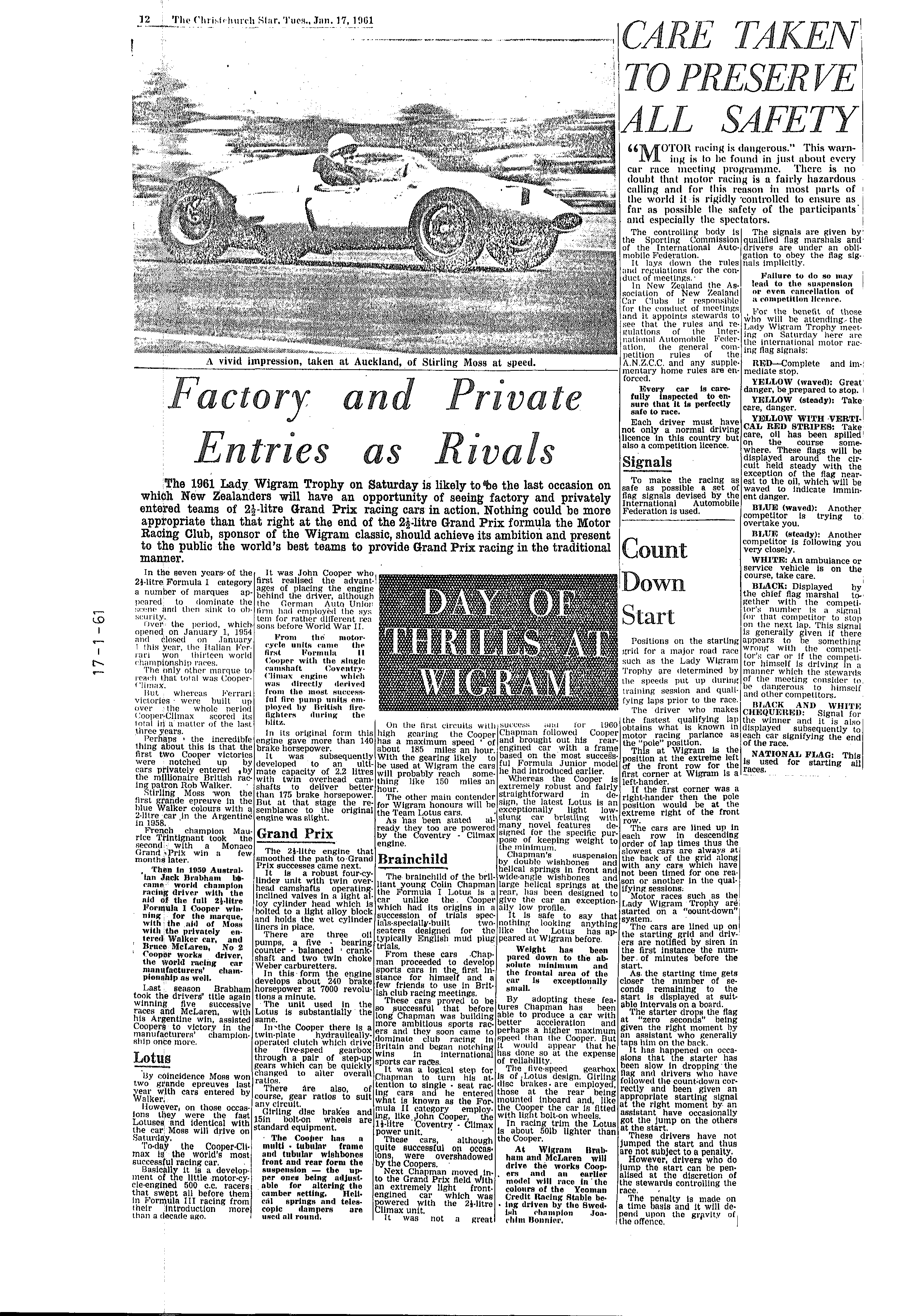
feature · The Christchurch StarLast chance to see 2.5-litre Grand Prix cars: Cooper and Lotus described
Feature saying the 1961 Lady Wigram Trophy would be the last chance for New Zealanders to see factory and private teams of 2.5-litre Grand Prix cars before the 1.5-litre formula. It describes the development of Cooper (from Formula Three motor-cycle engined cars to the rear-engined Cooper-Climax, winning world titles with Brabham and McLaren) and Colin Chapman's Lotus, with Moss's Rob Walker Lotus and the Yeoman Credit Coopers of Bonnier and Salvadori.
Facts
- The 1961 Lady Wigram Trophy was likely to be the last time New Zealanders would see 2.5-litre Grand Prix cars from factory and private teams.
- Cooper's rear-engined Cooper-Climax won the 1959 and 1960 world titles with Brabham.