Wigram TrophyMotor racing at Wigram airfield · Christchurch · 1949–2000
Home › Archive › 1959 › It was like this, see...
← 22 Jan 1959All 1959 pages22 Jan 1959 →
Scan of the clipping page, 22 January 1959
↗
Drag to move · scroll or pinch to zoom
photo

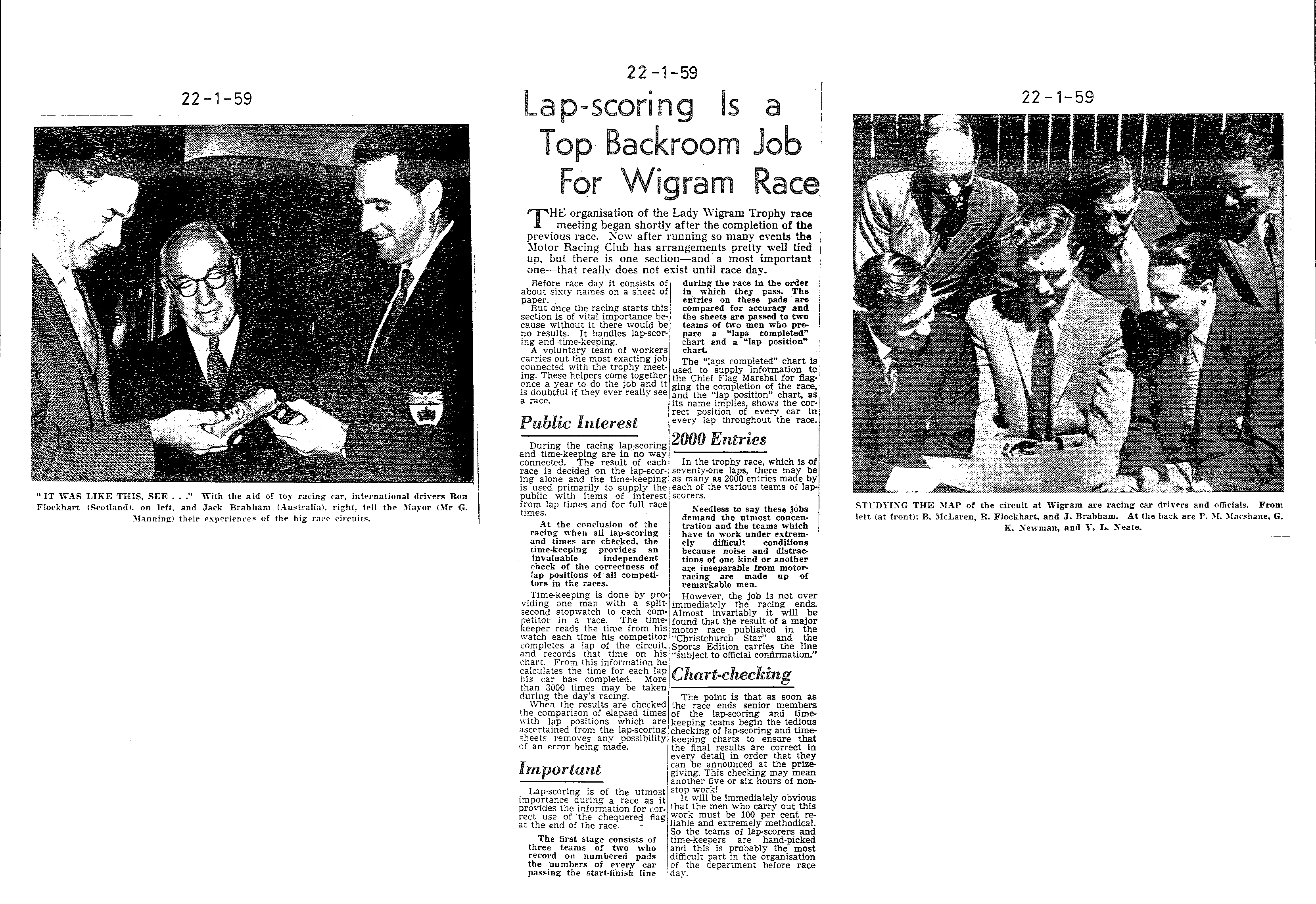
It was like this, see...

Ron Flockhart and Jack Brabham use a toy racing car to describe the big race circuits to Mayor G. Manning.

Photos

  • With the aid of a toy racing car, international drivers Ron Flockhart (Scotland), on left, and Jack Brabham (Australia), right, tell the Mayor (Mr G. Manning) their experiences of the big race circuits.
feature

Lap-scoring and time-keeping top backroom task for Wigram race

Describes the Motor Racing Club's volunteer lap-scoring and time-keeping teams: three teams of two record every car's number passing the start-finish line, compared for accuracy to produce lap-completed and lap-position charts; time-keepers use split-second stopwatches, one per competitor. In the 71-lap trophy race there may be 2000 entries by each scoring team and more than 3000 lap times during the day. Results are decided on lap-scoring alone; checking may take five or six hours after the race.

Facts

  • The Lady Wigram Trophy was 71 laps; lap-scoring teams could make 2000 entries each, and over 3000 lap times might be taken during the day.
  • Race results at Wigram were decided by lap-scoring alone, with time-keeping used for lap and race times and as an independent check.
photo

Drivers and officials studying the map of the Wigram circuit.

Photos

  • Studying the map of the circuit at Wigram are racing car drivers and officials. From left (at front): B. McLaren, R. Flockhart, and J. Brabham. At the back are P. M. MacShane, G. K. Newman, and V. I. Neate.
Read the OCR text
22-9-59 "IT WAS LIKE THIS, SEE .. With the aid of toy racing car, international drivers Ron Flockhart (Scotland), on left, and Jack Brabham (Australia), right, tell the Mayor (Mr G. Manning) their experiences of the hig race circuits. 22-1-59 Lap-scoring Top Backroo atenanda m J For Wigram Race THE organisation of the Lady Wigram Trophy race meeting began shortly after the completion of the previous race. Now after running so many events the Motor Racing Club has arrangements pretty well tied up, but there is one section-and a most important one- that really does not exist until race day. Before race day it consists off during the race in the order about sixty names on a sheet of which they pass. The paper. entries on these pads are But once the racing starts this compared for accuracy and section is of vital importance be- the sheets are passed to two cause without it there would be teams of two men who preno resuits. It handles lap-scor-i pare 8 "laps completed" ing and time keeping. chart and a "lap position" voluntary team of workers chart carries out the most exacting job The "laps completed" chart 1s connected with the trophy meet- used to suppiy information ing. These helpers come together the Chief Flag Marshal for fiag.' ence a year to do the job and it ging the completion of the race, is doubtful if they ever really see a race. every car in Public Interest every lap throughout the race. During the racing lap-scoring 2000 Entries and time-keeping are • in no way connected. The resuit of each: In the trophy race, which is of race is decided on the lap-scor- seventy-one laps, there may be ing alone and the time-keeping as many as 2000 entries made by is used primarily to supply the each of the various teams of lappublic with items of interest • scorers. from lap times and for full race Needless to say these jobs times. demand the utmost concen- At the conclusion of the tration and the teams which racing when all lap-scoring have to work under extremand times are checked, the ely difficult conditions time-keeping provides an because noise and distrac invaluable independent tions of one kind or another check of the correctness of are inseparable from motorlap positions of all competi- racing are made up of tors in the races. remarkable men. Time-keeping is done by pro-i However, the job is not over viding one man with a split- immediately the racing ends. second stopwatch to each com- Almost invariably it will be petitor in a race. The time found that the result of a major keeper reads the time from his motor race in the watch rech time his competitor monristchurch Starned and the completes a lap of the circuit, Sports Edition carries the line and records that time or his "subject to official confirmation." chart. From this information he calculates the time for each lap Chart-checking car has completed. More than 3000 times may be taken during the day's racing. The point is that as soon as When the results are checked | the race ends senior members the comparison of elapsed times of the lap-scoring and timewith lap positions which are keeping teams begin the tedious ascertained from the lap-scoring checking of lap-scoring and timesheets removes any possibility keeping, charts to ensure that of an error being made. the final results are correct in every detal in order tnat tney ¡ can be announced at tae prive Important giving. This checking may mean another five or six hours of non- is of the utmost! mportance during a race as it provides the information for correct use of the chequered flag at the end of the race. The first stage consists of three teams of T1r0 sho record numbered pads the numbers of every car passing the start-finish line stop work! It will be immediately obvious that the men who carry out this work must be 100 per cent reliable and extremely methodical. So the teams of lap-scorers and time-keepers are hand-picked and this is probably the most difficult part in the organisation of the department before race day. 22-9-59 STUDYING THE MAP of the circuit at Wigram are racing car drivers and officials. From left (at front): B. McLaren, R. Flockhart, and J. Brabham. At the back are P.M. Macshane, G. K. Newman, and V. I Neate.

Summaries and tables are machine-read from the scan and may contain errors: the scan is the record.