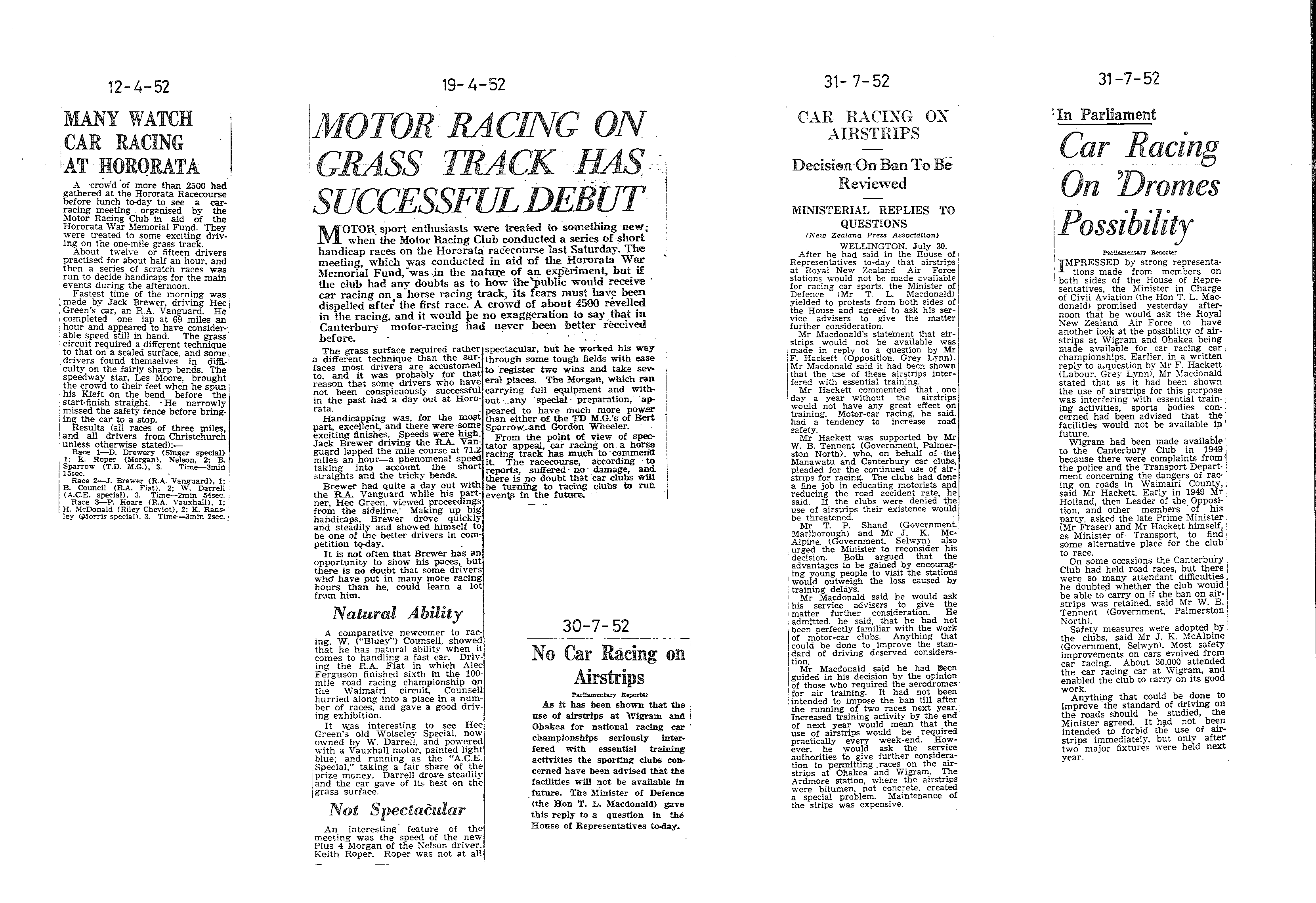
race reportMany watch car racing at Hororata
More than 2500 gathered before lunch at Hororata racecourse for the Motor Racing Club's meeting in aid of the Hororata War Memorial Fund on a one-mile grass track. Jack Brewer in Hec Green's R.A. Vanguard was fastest of the morning at 69 mph, and Les Moore spun his Kieft on the bend before the finishing straight. Scratch races were run to set handicaps for the afternoon.
Race 1 (three miles)
| 1 | D. Drewery (Christchurch) | Singer Special | 3:15 |
| 2 | K. Roper (Nelson) | Morgan | |
| 3 | B. Sparrow (Christchurch) | MG TD | |
Race 2 (three miles)
| 1 | J. Brewer (Christchurch) | R.A. Vanguard | 2:54 |
| 2 | B. Counsell (Christchurch) | R.A. Fiat | |
| 3 | W. Darrell (Christchurch) | A.C.E. Special | |
Race 3 (three miles)
| 1 | P. Hoare (Christchurch) | R.A. Vauxhall | 3:02 |
| 2 | H. McDonald (Cheviot) | Riley | |
| 3 | K. Ransley (Christchurch) | Morris special | |
Lap times
- Jack Brewer (R.A. Vanguard): 69 mph fastest race lap
featureMotor racing on grass track has successful debut
Review of the Motor Racing Club's first grass-track meeting at Hororata racecourse (a crowd of about 4500), judged a success and likely to prompt car clubs to use racing clubs' courses. Jack Brewer's R.A. Vanguard lapped the mile at 71.2 mph, Keith Roper's new Plus 4 Morgan won two races, W. 'Bluey' Counsell's R.A. Fiat (in which Alec Ferguson was sixth in the Waimairi 100-mile championship) impressed, and Hec Green's old Wolseley Special, now owned by W. Darrell with a Vauxhall motor and called the A.C.E. Special, took prize money.
Lap times
- Jack Brewer (R.A. Vanguard): 71.2 mph fastest race lap
Facts
- Hec Green's original Wolseley Special was by April 1952 owned by W. Darrell, repainted light blue, Vauxhall-engined and called the A.C.E. Special.
newsNo car racing on airstrips
In July 1952 Minister of Defence T. L. Macdonald announced that RNZAF airstrips at Wigram and Ohakea would no longer be available for racing car championships because they interfered with essential training.
Facts
- In July 1952 the Government advised car clubs that RNZAF airstrips at Wigram and Ohakea would not be available for racing in future.
news · New Zealand Press AssociationCar racing on airstrips: decision on ban to be reviewed
After protests from both sides of the House, Minister of Defence T. L. Macdonald agreed to ask service advisers to reconsider the ban on car racing on RNZAF airstrips. F. Hackett, W. B. Tennent, T. P. Shand and J. K. McAlpine argued that car clubs improved road safety and that about 30,000 attended the Wigram race; Wigram was made available in 1949 because of police and Transport Department objections to racing in Waimairi County. The ban was not to apply until after two races the following year.
Facts
- About 30,000 attended the car racing at Wigram, according to MP J. E. McAlpine in the July 1952 airstrip debate.
Read the OCR text
12-4-52 19-4-52
MANY WATCH
CAR RACING
AT HORORATA
A crowd of more than 2500 had
gatnered at the Hororata Racecourse
beiore lunch to-day to see сатracing meeting organised by the
Motor Racing Club in aid of the
Hororata War Memorial Fund. They
were treated to some exciting driving on the one-mile grass track.
About twelve or fifteen drivers
practised for about half an hour, and
then a series of scratch races was
run to decide handicaps for the main
events during the afternoon.
Fastest time of the morning was
made by Jack Brewer, driving Hec
Green's car, an R.A. Vanguard. He
completed one lap at 69 miles an
hour and appeared to have considerable speed still in hand. The grass
circuit required a different technique
to that on a sealed surface, and some
drivers found themselves difficulty on the fairly sharp bends. The
speedway star, Les Moore, brought
the crowd to their feet when he spun
his Kieft on the bend before the
start-finish straight. - He narrowly
missed the safety fence before bringing the car to a stop.
Results (all races of three miles,
and all drivers from Christchurch
unless otherwise stated):-
Race 1—D. Drewery (Singer special)
1; K. Roper (Morgan), Nelson, 2; B
Sparrow (T.D. M.G.), 3. Time3min
15sec.
Race 2-J. Brewer (R.A. Vanguard), 1;
B. Council (R.A. Fiat). 2; W. Darrell
(A.C.E. special), Time--2min 54sec.
Race 3P. Hoare (R.A. Vauxhall), I;
H. McDonald (Riley Cheviot), 2: K. Ransley (diorris special), 3. Time-3min 2sec.
MOTOR RACING ON
GRASS
TRACK
HAS
SUCCESSFUL DEBUT
Ut sport enthusiasts were treated to something new:
L when the Mofor Racing Club conducted a series of shor
handicap races on the Hororata racecourse last Saturday. The
War
meeting, semonial Fund, vas conducted in aid of the Hororata
was in the nature of an experiment, but if
the club had any doubts as to how the public would receive
car racing on a horse racing track, its fears raust have been dispelled after the first race. A crowd of about 4500 révelled
in the racing, and it would pe no exaggeration to say that in
Canterbury mofor-racing had never been better received
before.
The grass surface required rather spectacular, but he worzed his way
a . different technique than the sur- through some tough fields with ease
laces most drivers are accustomed. was probably for that to register two wins and take sevreason that some drivers who have eral places. The Morgan, which ran to, and it
not been conspicuously successful carrying full equipment and with
in the past had a day out at Horo-out any special preparation, ap
rata. for the most Peared to have much more power
Handicapping was, than either of the TD M.G.'S of Bert
part, excellent, and there were some Sparrow and Gordon Wheeler.
exciting anisnes. Speeds were bigh From the point of view of spec
Jack Brewer driving the R.A. . Vanguard lapped the mile course at 71.2 lator appeal, car racing on a horse racing track has much to commend
miles an nour-a phenomenal speed short it. Ine racecourse, according to
taking into account the reports, suffered no damage, and
straights and the tricky bends. there is no doubt that car clubs will
Brewer had quite a day out with be turning to racing clubs to run
the R.A. Vanguard while his part- levents in the future.
ner, Hec Green, viewed proceedings
from the sideline Making up big
handicaps. Brewer drove quickly
and steadily and showed himself tol
be one of the better drivers in competition to-day.
(Rare and doubt that some drivers opportunity to snow nis paces.
who have put in many more racing
hours than he, could learn a lot
from him.
Natural Ability
A comparative newcomer to rac
ing, W. ("Bluey") Counsell, showed
that he has natural ability when it
comes to handling a fast car. Driving the t.A. Fiat in which Alec
Ferguson finished sixth in the 100mile road racing championship on
the Waimairi circuit, Counsell
hurried along into a place in a number of races, and gave a good driving exhibition.
It was interesting to see Heci
Green's old Wolseley • Special. now
owned by W. Darrell, and powered
with a Vauxhali motor, painted light
blue, and running as the "A.C.E
Special," taking a fair share of the
prize money. Darreli drove steadıiyi
and the car gave of its best on thei
grass surtace.
Not Spectačular
An interesting feature of the
meeting was the speed of the new
Plus 4 Morgan of the Nelson driver.
Keith Roper. Roper was not at all
30-7-52
No Car Racing on
Airstrips
Parlamentary Reporte:
As it has been shown that the
use of airstrips at Wigram and
Obakea for national racing car
championships seriously interfered with essential training
activities the sporting clubs concerned have been advised that the
facilities will not be available in
future. The Minister of Defence
(the Hon I. I. Macdonald) gave
this reply to a question in the
House of Representatives to-day.
31-7-52 31-7-52
CAR RACING ON
AIRSTRIPS
Decision On Ban To Be
Reviewed
MINISTERIAL REPLIES TO
QUESTIONS
(New Zealana Press Association)
WELLINGTON. July 30.
After he had said in the House of
Representatives to-day that airstrips
Royal New Zealand AII Force
stations would not be made available
for racing car sports,, the Minister of
Defence (VIr T. L. Macdonald)
yielded to protests from both sides of
the House and agreed to ask his service advisers give the matter
further consideration.
Mr Macdonald's statement that airstrips would not be available was
made in reply to a question by Mr
Hackett (Opposition. Grey Lynn).
Mr Macdonald said it had been shown
that the use of these airstrips interfered with essential training.
Mr Hackett commented that . one
day a year without airstrips
would not have any great effect on
training. Motor-car racing, he said
had a tendency to increase road
safet Hackett was supported by Mr
W. B. Tennent (Government, Palmerston North), who, on behalf of the
Manawatu and Canterbury car clubs,
pleaded for the continued use of airstrips for racing. The clubs had done
a fine job in educating motorists and
reducing the road acciaent rate,
said. If the clubs were denied the
use of airstrips their existence would
be threatened.
Mr T. P. Shand (Government,
Marlborough) and Mr J. K. Mc-
Alpine (Government. Selwyn) also
urged the Minister to reconsider his
decision. Both argued that the
advantages to be gained by encouraging young people to visit the stations
would outweigh the loss caused by
training deláys.
Mr Macdonald said he would ask
service advisers give the
matter consideration. He
i admitten further he said, that he had not
been perfectly familiar with the work
motor-car clubs. Anything that
could be done to improve the standard of driving deserved consideration.
Mr Macdocald said he had been
guided in his decision by the opinion
of those who required the aerodromes
for air training. It had not been
intended to impose the ban till after
the running of two races next year.
Increased training activity by the end
of next year would mean that the
use of airstrips would be required
practically every week-end. However. he would ask service
authorities to give further consideration to permitting races on the airstrips at Ohakea Wigram. The
Ardmore station, where the airstrips
were bitumen, not concrete, created
a special problem. Maintenance of
the strips was expensive.
In Parliament
Car Racing
On 'Dromes
Possibility
Parliamentary Reporter
IMPRESSED by strong representa- tions made from members
both sides of the House of Repre
sentatives, the Minister in Charge
of Civil Aviation (the Hon T. L. Macdonald) promised yesterday afternoon that he would ask the Royal
New Zealand Air Force to have
another look at the possibility of airstrips at Wigram and Ohakea being
made available for car racing car:
championships. Earlier, in a written
reply to a question by Mr F. Hackett
(Labour, Grey Lynn), Mr Macdonald
stated that as it had been shown
the use of airstrips for this purpose
was interfering with essential training activities, sports bodies concerned had been advised that the
facilities would not be available in'
suwleramanterbury Wigram had been made available
to the Canterbury Club in 1949
because there were complaints from !
the police and the Transport Depart.
ment concerning the dangers of racing on roads in Waimairi County, i
said Mr Hackett. Early in 1949 Mr
Holland, then Teamembers Of Oss tion, and other members
party, asked the late Prime Minister
(Mr Fraser) and Mr Hackett himself
as Minister of Transport, to find
some alternative place for the club
to race.
On some occasions the Canterbury
Club had held road races, but there
were so many attendant difficulties
he doubted whether the club would!
be able to carry on if the ban on airstrips was retained, said Mr W. B.
Tennent (Government, Palmerston
North).
Safety measures were adopted by:
the clubs, said Mr J. E. McAlpine
(Government, Selwyn). Most safety
improvements on cars evolved from
car racing. About 30,000 attended
the car racing car at Wigram, and
enabled the club to carry on its good
work.
Anything that could be done to
improve the standard of driving on
the roads should be studies been Minister agreed. It had not
intended to forbid the use of airstrips immediately, but only, after
two major fixtures were held next
year.
Summaries and tables are machine-read from the scan and may contain errors: the scan is the record.