news · The Christchurch Star-SunHad their revenge
A humorous note about a young spectator at the Wigram races who watched from a ladder near the hangar corner and shouted that a car was over when it was not; the spectators had their revenge when his ladder collapsed.
news · The Christchurch Star-SunCar race inquiry
A letter queried why H. G. R. Sedgley was told only ten minutes before the prizegiving that he had been disqualified in the Wigram reliability test. Canterbury Car Club president H. D. Christie said he was disqualified for taking on water, contravening a rule he admitted knowing, and the protest arrived just before the prizegiving.
Facts
- H. G. R. Sedgley was disqualified from the Wigram high-speed reliability test in February 1950 for taking on water.
newsSpecial aircraft for car race
Canterbury Car Club members chartered a special NAC Douglas aircraft to fly to Ohakea on 18 March for the 100-mile car race on the aerodrome there.
featureAustralian drivers like road courses
Australian driver Gary Coglan said New Zealand drivers have ability but lack race experience, and that Wigram can be lapped at 100 mph but Australians prefer road circuits. He recommended a handicap system for local racing, predicted six top Australians including Frank Kleinig (Hudson-powered special, 150 mph) for next year's championship, urged repositioning the Wigram pits, and rated Hec Green easily the best driver on the course.
Facts
- Coglan said at Easter racing meetings at Bathurst in Australia as many as 25,000 spectators would attend and Wigram's pits were too close to the hangar at the end of the straight.
- Coglan said safety straps were compulsory in Australia but not in New Zealand racing in 1950.
race reportCar race at Wigram
Hec Green won the second annual NZ motor-car road-racing championship at Wigram easily after Australian Gary Coglan, who had led, was forced to retire after 47 of the 50 two-mile laps. Mrs S. Lupp of Dunedin drove a courageous race for second. Green took just under 91 minutes for the 100 miles while Coglan averaged 75 mph on some of the later laps.
Lap times
- Gary Coglan (MG TC supercharged): 75 mph fastest race lap
Facts
- Coglan retired in the 1950 Wigram race after 47 of 50 laps.
Photos
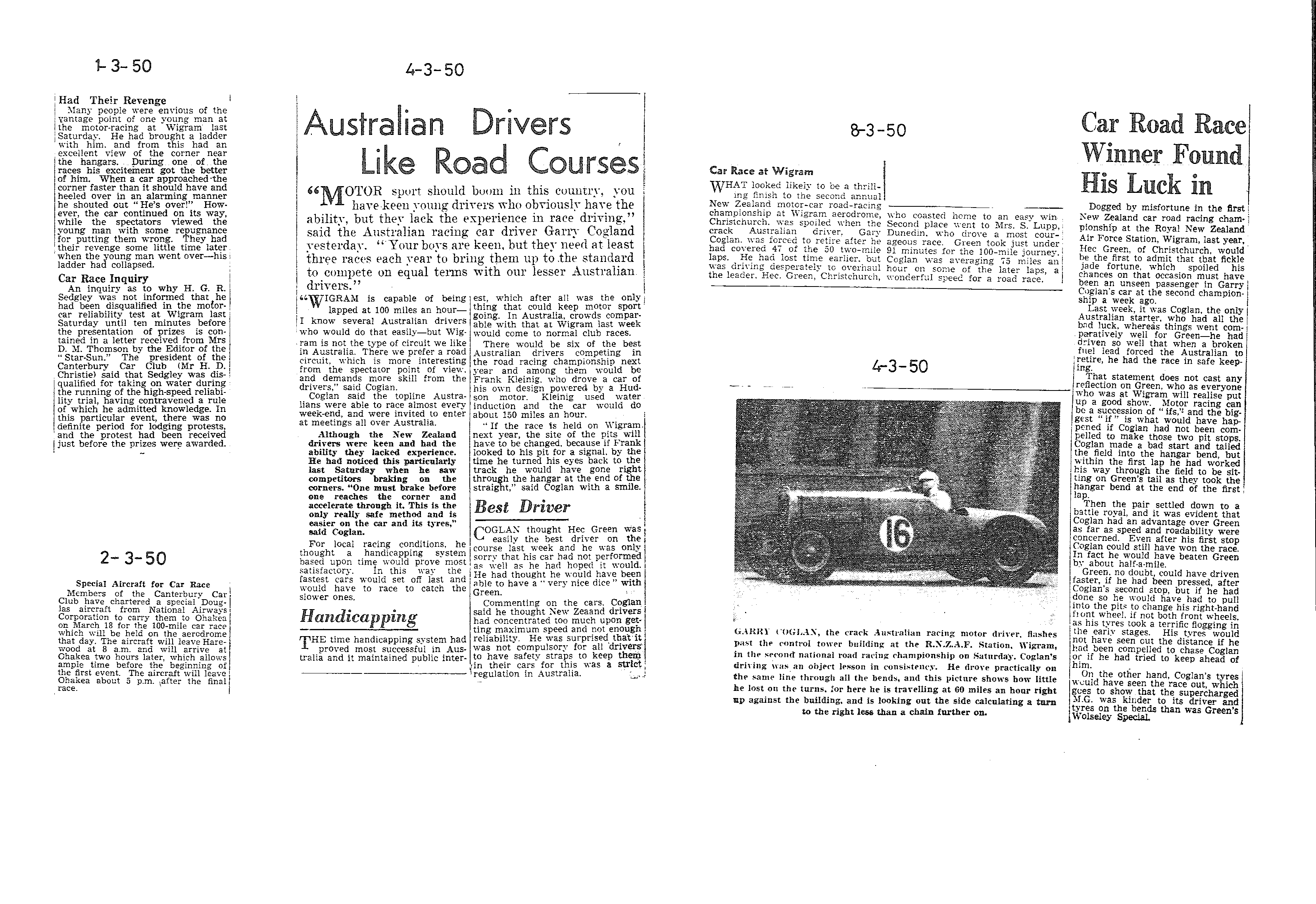
- Garry Coglan, the crack Australian racing motor driver, flashes past the control tower building at the RNZAF Station, Wigram, in the second national road racing championship on Saturday. His driving was an object lesson in consistency; he drove practically on the same line through all the bends, here travelling at 60 mph right up against the building and calculating a turn to the right less than a chain further on.
featureCar road race winner found his luck
Analysis of the 1950 Wigram championship: Hec Green, unlucky in 1949, had the race in safe keeping when Coglan's fuel line broke. Coglan had made a bad start, caught Green within a lap and had an advantage in speed and roadability, and even after his first stop could have beaten Green by half a mile. Green's tyres took a heavy flogging and would not have lasted had he chased Coglan, showing the supercharged MG was kinder on tyres than the Wolseley.
Facts
- Coglan made two pit stops in the 1950 Wigram race, tailing the field into the hangar bend at the start before catching Green within a lap.
Read the OCR text
13-50 4-3-50
Had Their Revenge
Many people were envious of the
vantage point of one young man at
the motor-racing at Wigram last
Saturday. He had brought a ladder
with him. and from this had an
excellent view of the corner near
the hangars. During one of the
races his excitement got the better
of him. When a car approached the
corner faster than it should have and
heeled over in an alarming he shouted out "He's over, manner
However, the car continued on its way,
while the spectators viewed the
young man with some repugnance
for putting them wrong. They had
their revenge some little time later
when the young man went over-nis
ladder had collapsed.
Car Race Inquiry
An inquiry as to why H. G. R.
Sedgley was not informed that
had been disqualified in the motorcar reliability test at Wigram last
Saturday until ten minutes before
the presentation of prizes is contained in a letter received from Mrs
D. M. Thomson by the Editor of the
"Star-Sun." The president of the
Canterbury Car Club Mr H. D.
Christie) said that Sedgley was disqualified for taking on water during
the running of the high-speed reliability trial, having contravened a rule
of which he admitted knowledge. In
this particular event, there was no
definite period for lodging protests,
and the protest had been received
| just before the prizes were awarded.
2-3-50
Special Aircraft for Car Race
Members of the Canterbury Car
Club have chartered a special Douglas aircraft from National Airways
Corporation to carry them to Ohakea
on March 18 for the 100-mile car race
which will be held on the aerdrome
that day. The aircraft will leave Harewood at 8 a.m. and will arrive at
Chakea two hours later, which allows
ample time before the beginning off
the first event. The aircraft will leave
Ohakea about 5 p.m. after the final!
Australian
Drivers
Like Road
Courses
"MOTOR spurt should have keen roung dri
abiliti, but ther lack the e
said the Australian racing
resterday: • Your bors are
three races each rear to bri
to compete on equal terms
drivers."
WIGRAM is capable of being
lapped at 100 miles an hour—
I know several Australian drivers
who would do that easily-but Wigram is not the type of circuit we like
in Australia. There we prefer a road
circuit, which is more interesting
from the spectator point of view.
and demands more skill from the
drivers, said Cogian.
Cogian said the topline Australians were able to race almost every
week-end, and were invited to enter
at meetings all over Australia.
Although the New Zealand
drivers were keen and had the
ability they lacked experience.
He had noticed this particularly
last Saturday when he saw
competitors braking on the
corners. 'One must brake before
one reaches the corner and
accelerate through it. This is the
only really safe method and is
easier on the car and its tyres,"
said Cogian.
For local racir
thought a hand
based upon time
satisfactory. in
fastest cars would
would have to
slower ones.
ng conditions, he
dicapping system
would prove most
• this way the
d set off last and
'ace to catch the
Handicap
THE time nandi proved most
tralia and it main
ping
capping system had
successful in Austained public inter-
boom in this countr!: you
ivers mho obriously have the
'sperience in race driving."
car driver Garry Cogland
keen, but they need at least
ing them up to the standard
with our lesser Australian
est, which after all was the only
thing that could Keep motor sport
going. In Australia, crowds comparable with that at Wigram last week
would come to normal club races.
There would be six of the best
Australian drivers competing in
the road racing championship next
year and among them would be
Frank Kleinig. who drove a car of
his own design powered by a Hudson motor. Kleinig used water
induction and the car would do
about 150 miles an hour.
"If the race is held on Wigram
next year, the site of the pits will
have to be changed, because if Frank
looked to his pit for a signal. by the
time he turned his eyes back to the
track he would have gone right
through the hangar at the end of the
straight," said Coglan with a smile
Best Driver
COGLA.! though easily the bes
course last week
sorry that his car!
as well as he har
He had thought he
able to have a "ve
t Hec Green was
st driver the
and he was only
had not performed
d hoper it would
e would have been
ry nice dice " with
Green.
Commenting on the cars. Coglan
said he thought New Zeaand drivers
had concentrated too much upon getting maximum speed and not enough
reliability. He was surprised that it
was not compulsory for all drivers
to have safety straps to keep them
in their cars for this was a strict
'regulation in Australia.
83-50
Car Race at Wig
WHAT looked lit
ing finish to
New Zealand mot
championship at 1
Christchurch. was
crack Australian
Coglan. was forcec
had covered 47
laps. He had losi
was driving despe
ram
keil to be a thrilithe seconă annual
or-car road-racing
Wigram aerodrome,
spoilec when the
ariver. Gary
: to retire after he
f the 50 two-mile
t time earlier. but
eratelr to overhanl
the leader. Hee. Green, Christchure
who coasted hem
Second place wen
Dunedin. who dr
ageous race. Gree
91 minutes for the
Coglan was avera
hour on some of
moncertal speed f
le to an easy win
it to Mrs. S. Lupo,
rove a most couren took just under
e 100-mile journey.
aging 75 miles an
i the later laps, a
for a road race.
43-50
16
GARRY COGLAN, the crack Australian racing motor driver, flashes
past the control tower building at the R.N.J.A.F. Station. Wigram,
in the second national road racing championship on Saturday. Coglan's
driving was . all oi
the same line thr
he lost on the tur
up against the bu
bject lesson in consistener. He drove practically on
ough all the bends, and this picture shows how little
ns. for here he is travelling at 60 miles an hour right
ilding, and is looking out the side calculating a turn
the right less than a chain further on.
Car Road Race
Winner Found
His Luck in
Dogged by misfortune in the first!
New Zealand car road racing cham-!
pionship at the Royal New Zealand
Air Force Station, Wigram, last year,
Hee Green, of Christchurch, would
be the first to admit that that fickle
jade fortune. which spoiled his
chances on that occasion must have
been an unseen passenger in Garry!
Coglan's car at the second championship a week ago.
Last week, it was Cogian, the only
Australian starter, who had all the
bra luck, whereas things went com-i
paratively well for Green—he had
driven so well that when a broken
fuel lead forced the Australian to
retire, he had the race in safe keepjing
That statement does not cast any
up a good show. Motor racing can
bè a succession of " ifs," and the biggest "if" is what would have happened if Cogian had not been compelled to make those two pit stops.
Coglan made a bad start and tailed
the field into the hangar bend, but
within the first lap he had worked
his way through the field to be sithangar bend at the end of the first: has on Green's tail as they took the
lap.
Then the pair settled down to a
battle royal, and it was evident that
Coglan had an advantage over Green
as tar as speed and roadability were
concerned. Even after his first stop
Cogian could still have won the race.
In fact he would have beaten Green
bs about half-a-mile.
Green. no doubt, could have driven
faster, if he had been pressed, after
Cogian's second stop, but if he had
done so he would have had to pull
into the pits to change his right-hand
front wheel, if not both front wheeis.
as his tyres took a terrific flogging in
the eariy stages. His tvres would
not have seen cut the distance if he
had been compelled to chase Coglan
or if he had tried to keep ahead of him.
On the other hand, Coglan's tyres
Kuld have seen the race out, which
goes to show that the supercharged
M.G. was kinder to its driver and
tyres on the bends than was Green's
Wolseley Special.
Summaries and tables are machine-read from the scan and may contain errors: the scan is the record.